
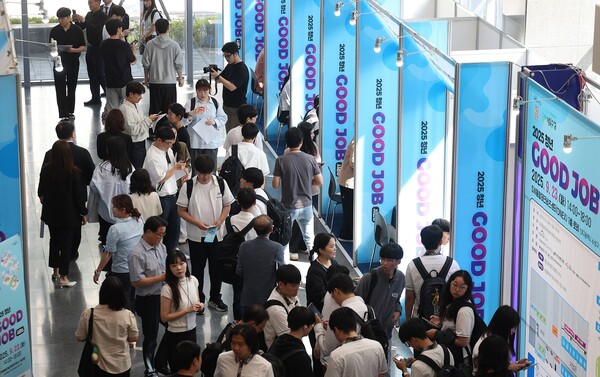
The employment rate for people in their 20s fell for the first time in 5 years. The group recorded a double negative as the employment rate fell last year while the number of employed people declined for a third straight year.
An analysis of the Economically Active Population Survey by the National Data Agency, formerly Statistics Korea, showed that the number of employed people in their 20s stood at 3,442,000 last year. That was down 170,000 from a year earlier. This marked the third consecutive annual decline.
The decline was 82,000 in 2023. It was 124,000 in 2024 and widened further last year.
A falling population is cited as one reason the number of employed people in their 20s has declined. The population in this age group has fallen for 5 straight years since 2021.
Recently, factors beyond demographics also appear to have played a role.
Last year, the population in their 20s fell 3.5 percent from a year earlier, but the decline rate in employment was larger at 4.7 percent. This can also be seen in the employment rate, which measures the share of people aged 15 and older who are employed at a specific point in time.
The employment rate for people in their 20s stood at 60.2 percent last year, down 0.8 percentage point from 2024.
The employment rate for people in their 20s fell from the previous year for the first time in 5 years, since 2020 when the job market froze due to the COVID-19 pandemic.
Yang Joon-suk, a professor of economics at the Catholic University of Korea, said it meant the number of employed people was declining faster than the fall in the population of those in their 20s. He said it could also be seen as a growing tendency for people to wait until their 30s in an effort to find the jobs they want, whereas they used to settle employment issues in their 20s.
The number of people in their 20s classified as "resting," one status within the economically inactive population, came to 408,000 last year. That was the highest in 5 years since 415,000 in 2020.
The share of those "resting" among the population in their 20s was 7.1 percent last year, the highest since the figure was first compiled in 2003.
For people in their 30s, the number classified as "resting" stood at 309,000 last year, the highest since 2003.
Reasons the "resting" group, which is not included in unemployment statistics, is spreading among young people can also be inferred from results of an additional survey of the economically inactive population in August last year.
In that survey, 34.1 percent of those aged 15 to 29 who answered they were "resting" responded that they were resting because it was difficult to find the job or work they wanted. This can also be interpreted as meaning that not enough jobs are being supplied that match young people’s expectations.
Among those in their 30s, 32.0 percent answered they were resting because they were not in good health, while 27.3 percent said it was difficult to find the job they wanted.
Job administrative statistics suggest that large companies may not recently have sufficiently widened hiring opportunities for young people with little or no work experience.
The number of large-company jobs stood at 4,426,000 in 2024, up 17,000 from a year earlier. But the share of continuing jobs occupied by the same workers from the previous year rose 0.8 percentage point to 84.4 percent.
Replacement jobs hired due to entries and exits accounted for 11.5 percent of all large-company jobs. New jobs created through business expansion or the creation of companies were limited to 4.1 percent.
[Yonhap News Agency]
 Online Team
d-today@d-today.co.kr
Online Team
d-today@d-today.co.kr