
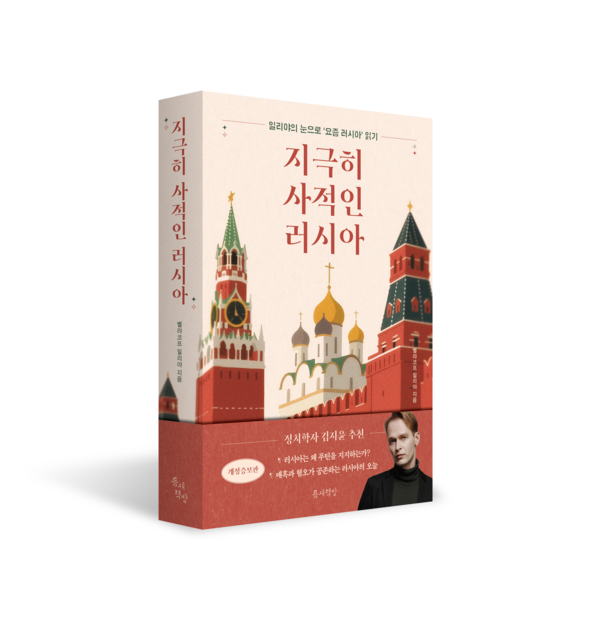
A revised and expanded edition of “Highly Personal Russia,” which explains the internal logic and worldview of Russian society from a Russian perspective, has been published.
The publisher said the book points to why people have failed to understand Russia, and offers a new perspective on Russia and Russians amid a more complex international situation after the Russia-Ukraine war.
Author Ilya Belyakov is from Vladivostok in Russia and has been active after settling in South Korea. He studied Korean studies at Far Eastern Federal University in Russia, then completed a master’s programme in Korean language and literature at Yonsei University. After working at Samsung Electronics, he is now a professor in Russian language and literature in the Faculty of Foreign Languages at Suwon University. After acquiring South Korean citizenship in 2016, he has introduced Russian culture to South Korean society through broadcasting, lectures and writing, serving as a bridge between the two countries.
The revised and expanded edition deals in earnest with the Russia-Ukraine war, which became reality after the first edition was published. It also supplements the international situation and perceptions inside Russia that were difficult to fully explain at the time of the first edition because the war was in its early stage.
The author makes clear his position that defines Russia as a war criminal state, while also examining the background of the war and how Russian society perceives it. He said the aim is not to defend Russia, but to accurately understand what is wrong in their claims in order to grasp the causes and structure of the war.
The latter part also covers the daily life and culture of Russians. The editorial department of publishing house Teumsae Bookstore said, “Rather than emotionally defining or simplifying Russia, understanding the internal logic of Russian society is necessary to read the post-war world order.” It added, “Highly Personal Russia will be the most realistic starting point for understanding Russia, as a general-interest book meant to be viewed through understanding rather than prejudice toward Russia.”
 Chigyu Hwang
delight@d-today.co.kr
Chigyu Hwang
delight@d-today.co.kr