
The Korean-German Chamber of Commerce and Industry (KGCCI) said on Thursday it held the “2026 KGCCI Economic Outlook” event on Wednesday at Signiel Busan with the Busan-Jinhae Free Economic Zone Authority (BJFEZ). The event was set up to discuss ways to develop bilateral business ties and the outlook for the South Korean economy. About 50 figures from politics and business attended the first-session forum and about 120 attended the dinner.
Marie Antonia von Schoenburg, head of KGCCI, said the partnership between the two countries was showing stronger unity than ever amid deepening uncertainty in the global economy. She said cooperation went beyond trade to share key values of innovation, sustainability and mutually beneficial development. She said KGCCI would continue to serve as a bridge between the two economies by helping companies and policy authorities communicate closely and realise innovative ideas.
The event began with welcome remarks by von Schoenburg and Park Sung-ho, commissioner of BJFEZ. It then proceeded in order with Georg Schmidt, German ambassador to South Korea, Katarina Viklenko, Korea representative of Germany Trade and Invest (GTAI), and Charlie Lay, chief economist at Commerzbank.
Schmidt shared his views on recent political trends and bilateral relations and stressed that cooperation between partners sharing values such as South Korea and Germany was not a choice but a necessity to resolve major challenges. He said the Asia-Pacific Conference of German Business (APK), to be held in Seoul in October, was the German business community’s largest event in the Asia-Pacific region. He said the conference would be an important opportunity to further tighten ties between the two countries. APK is an event attended by about 800 political and economic leaders from Germany and the Asia-Pacific region, and a visit to South Korea by high-level German political and business figures is also expected.
Lay presented a macroeconomic outlook and said South Korea’s economy would enter a recovery this year with growth in the 2 percent range after a weak 2025. He said the global outlook was relatively optimistic due to growth in the United States and Germany, but that geopolitical risks and a reorganisation of the international order remained threats requiring caution.
Viklenko said demand for semiconductors and ICT equipment, driven by expanded government spending and the global AI boom, would underpin South Korea’s growth in 2026. She said a weak won, an economic structure concentrated in the IT industry and global trade conflicts were continuing challenges.
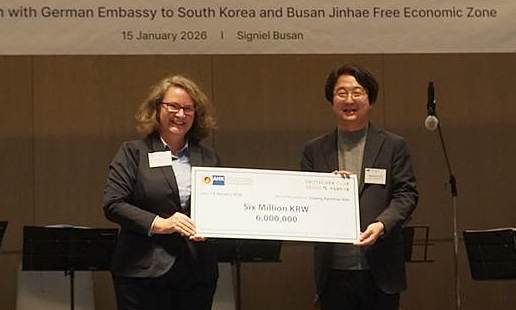
KGCCI and its member companies delivered a 6,000,000 won donation to Soyang Rainbow Hill in Busan, formerly Soyang Orphanage. The donation is to be used for facility repairs and to create a residential environment for children and teenagers. The “Soyang Orchestra,” made up of youths from Soyang Rainbow Hill, gave a special performance.
Von Schoenburg said economic success is only complete when accompanied by social responsibility. She said KGCCI believes companies are a driving force behind growth and also a key actor leading social change. She said it would continue to work to create social value for “sustainable success.”
 Daegeon Seok
d2dg@d-today.co.kr
Daegeon Seok
d2dg@d-today.co.kr