
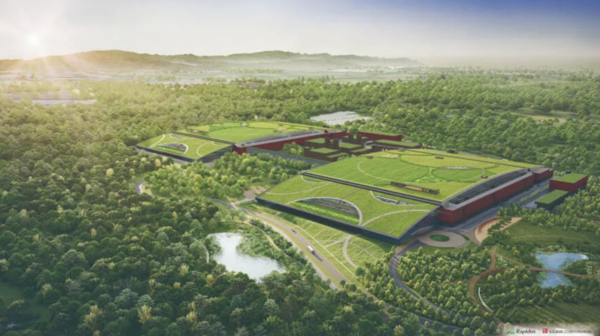
Japan's semiconductor company Rapidus is preparing large equipment orders ahead of the April launch of a research and development centre in Hokkaido, raising the likelihood that South Korean back-end processing companies can enter. Japan is seen as world-class in front-end tools, but its ecosystem for back-end equipment for high-bandwidth memory (HBM) and 2.5D packaging is weak. That is expected to open opportunities for Korean toolmakers to expand into Japan.
Rapidus is expected to move ahead with full-scale equipment orders ahead of its April start-up in Hokkaido. Rapidus began pilot production of 2-nanometre semiconductors at its Chitose plant in Hokkaido in April last year and unveiled its first prototype wafer in July. Tool deliveries have already proceeded in stages, but additional orders and final setup are needed for the April full launch of the back-end R&D centre, 'RCS (Rapidus Chiplet Solutions)'.
Rapidus is a consortium of eight Japanese companies founded in 2022 and aims to mass-produce 2-nanometre semiconductors by 2027. With Japan set to execute a semiconductor budget of about 80 billion yen for 2-nanometre chip development and the advancement of advanced packaging technology in February and March, in line with fiscal 2026 starting in April, that period is expected to be a golden time for equipment suppliers as purchase orders (POs) concentrate.
RCS, which Rapidus is building, is a key base for developing chiplet-based advanced packaging technologies. The Japanese government is pushing to revive its domestic semiconductor industry by providing Rapidus with cumulative support of more than 3 trillion yen (about 27 trillion won). The centre, to be built on the site of a Seiko Epson plant near the Chitose facility in Hokkaido, will research next-generation back-end technologies including FC-BGA (flip-chip ball grid array), silicon interposers and hybrid bonding. To meet the April start-up target, final purchase orders (POs) and equipment installation plans typically need to be confirmed by February, given standard tool lead times.
Japan is strong in front-end tools led by Tokyo Electron (TEL), but the back-end equipment situation is different. Japan has relied on foreign companies such as BESI and ASMPT for key equipment for 2.5D and 3D packaging, according to the Ministry of Economy, Trade and Industry (METI). Japan lacks its own technological capabilities in areas such as TSV (through-silicon via) bonding equipment and hybrid bonding equipment, which are essential for implementing the chiplet architecture of the 2-nanometre chips Rapidus is targeting.
◆Possibility rises for entry into Japan market on HBM mass-production experience↑
For Rapidus, which is accelerating, the timing calls for proven equipment. Rapidus Chief Executive Atsuyoshi Koike said, "In a situation where product cycles are shortening, shortening development time through inter-company cooperation is key," and added, "Japan's advanced logic semiconductor technology is 10 to 20 years behind."
To quickly narrow such a technology gap, adopting already proven equipment is essential. Yield and reliability data Korean companies have built through HBM mass production can be an attractive option for Rapidus.
Korean equipment companies have already proven their technological capabilities in the HBM market. A representative example is Hanmi Semiconductor. Hanmi Semiconductor supplied TC bonders (thermocompression equipment) worth 55.2 billion won to SK Hynix last year and recently signed an additional contract worth 9.65 billion won.
Hanwha Semitec also signed an equipment supply contract worth 80.5 billion won with SK Hynix. As HBM demand exceeds supply, semiconductor companies are shifting from a single-vendor to a multi-vendor system, expanding global sales opportunities for Korean equipment makers.
South Korea and Japan are expected to step up cooperation in advanced industries. President Lee Jae-myung and Japanese Prime Minister Sanae Takaichi agreed at a summit on the 13th to begin working-level consultations in advanced industries including artificial intelligence (AI). Lee said, "This year is a starting point to look back on the past 60 years of Korea-Japan relations and prepare for a new 60 years ahead," stressing the importance of cooperation between the two countries in advanced technologies including semiconductors.
This cooperation stance at the government level in both countries is becoming a backdrop that raises the possibility of cooperation between Rapidus and Korean equipment companies. It also helps the Korean industry that Japan's industry is feeling burdened about using Chinese-made equipment, which has been rapidly emerging recently.
Rapidus is currently working with IBM on the development of 2-nanometre-class gate-all-around (GAA) process technology and is also expanding cooperation on advanced packaging technology with Germany's Fraunhofer and Singapore's ASTAR IME. An industry official said Korean equipment companies also have sufficient potential to join the global cooperation network Japan is pursuing.
 Daegeon Seok
d2dg@d-today.co.kr
Daegeon Seok
d2dg@d-today.co.kr