
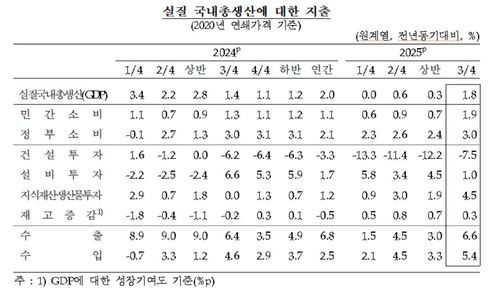
Domestic demand, including consumption and investment, strengthened and exports remained firm, lifting South Korea’s economy more than 1 percent from the previous quarter in the third quarter. It was the highest growth in 15 quarters.
The Bank of Korea said on Dec. 3 that real gross domestic product grew 1.3 percent in the third quarter on a preliminary basis from the previous quarter. The figure was 0.1 percentage point higher than the advance estimate of 1.2 percent released on Oct. 28 and the strongest since the fourth quarter of 2021, when growth reached 1.6 percent.
Growth hit 1.2 percent in the first quarter of last year, then fell to minus 0.2 percent in the second quarter. It was flat at 0.1 percent in both the third and fourth quarters, then slipped again to minus 0.2 percent in the first quarter of this year. It rebounded to 0.7 percent in the second quarter and held its momentum in the third quarter.
Kim Hwayong, director of national accounts at the Bank of Korea, said a fourth-quarter growth rate of minus 0.4 percent to minus 0.1 percent would still allow annual growth of 1 percent. He said annual growth of 1.1 percent is arithmetically possible if fourth-quarter growth is zero or higher. The bank’s forecast issued on Nov. 27 put fourth-quarter growth at 0.2 percent.
Kim said the preliminary third-quarter figure was 1.33 percent when calculated to the second decimal place, about 0.1 percentage point higher than the advance estimate, adding roughly 0.08 percentage point to annual growth. He added that the annual figure still needed further monitoring.
By sector, private consumption rose 1.3 percent. Spending increased for goods such as passenger cars and telecom devices and for services such as restaurants and medical care. Government consumption also grew 1.3 percent, driven by spending on goods and health insurance benefits. Private consumption reached its highest level since the third quarter of 2022, while government consumption saw its strongest gain since the fourth quarter of 2022.
Facility investment rose 2.6 percent, led by machinery, including semiconductor manufacturing equipment. Exports rose 2.1 percent due to strong semiconductor and automobile shipments. Imports increased 2.0 percent, led by machinery, equipment and vehicles, but grew more slowly than exports. Construction investment rose 0.6 percent, driven by civil engineering, ending six quarters of contraction.
Compared with the advance estimate, growth was revised up for construction investment by 0.7 percentage point, intellectual property product investment by 1.0 percentage point, facility investment by 0.2 percentage point, government consumption by 0.1 percentage point, exports by 0.6 percentage point and imports by 0.7 percentage point.
Domestic demand and net exports contributed 1.2 percentage points and 0.1 percentage point, respectively, to third-quarter growth. Domestic demand’s contribution jumped 0.8 percentage point from the second quarter’s 0.4 percentage point. Private consumption, government consumption and facility investment contributed 0.6 percentage point, 0.2 percentage point and 0.2 percentage point, respectively.
Kim said domestic demand’s contribution to third-quarter growth expanded significantly. He said private consumption made a large positive contribution and government consumption held at the previous quarter’s level.
He said cumulative growth for the first to third quarters was 0.8 percent, while construction investment subtracted 1.5 percentage points, weighing on growth. He said construction investment could improve with semiconductor plant construction and government spending on social overhead capital and would not act as a major drag on next year’s growth.
Manufacturing grew 1.5 percent, driven by transport equipment and computers, electronics and optical products. Services rose 1.4 percent due to recoveries in wholesale and retail, accommodation and food services, transport and finance and insurance. The electricity, gas and water sector, which shrank 5.4 percent in the second quarter, rebounded 5.5 percent, led by electricity supply.
Construction grew 0.7 percent in the third quarter, recovering from a 3.6 percent decline in the second quarter on civil engineering gains. Agriculture, forestry and fisheries fell 4.6 percent as farming, livestock, related services and fisheries weakened.
Nominal gross national income fell 0.3 percent from the previous quarter. Nominal net factor income from abroad was 8 trillion won, down about 6 trillion won from the second quarter, and below the nominal GDP growth rate of 0.7 percent.
Real GNI rose 0.8 percent. Real net factor income from abroad fell from 10.2 trillion won to 8.6 trillion won, and real trade losses widened from 8.6 trillion won to 10.3 trillion won due to worsening terms of trade, leaving real GNI growth below real GDP growth of 1.3 percent.
[Yonhap]
 Online Team
d-today@d-today.co.kr
Online Team
d-today@d-today.co.kr