
[Digital Today reporter Oh Sang-yup (오상엽)] The government will, in principle, limit major shareholders of digital asset exchanges to a 20 percent stake. It will allow up to 34 percent with approval from the Financial Services Commission, and plans for won-denominated stablecoins to be issued in the early stages of the system mainly by consortia in which banks hold a majority stake.
The Financial Services Commission on the 24th held a Virtual Asset Committee meeting chaired by FSC Chairman Lee Ock-won (이억원) and released a draft bill titled the Act on Innovation in the Digital Asset Industry and User Protection.
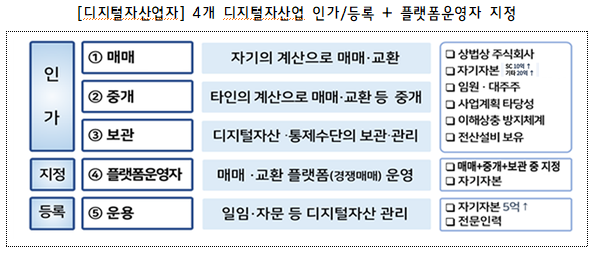
Under the draft, the FSC will designate as a "digital asset platform operator" a company that has received approval for digital asset trading, brokerage and custody and serves as distribution infrastructure.
The exchange will be subject to a 20 percent ownership cap for major shareholders, similar to alternative trading systems (ATS) in capital markets. Shareholders such as financial companies that have received FSC approval may hold up to 34 percent. If the cap is exceeded, voting rights for the excess stake will be restricted.
Existing exchanges will be granted a three-year grace period after designation. Small and mid-sized exchanges may receive an additional grace period of up to three years depending on circumstances.
Governance regulation for exchanges will also be tightened. Exchanges will be required to appoint outside directors as a majority of the board and to set up an audit committee and appoint a compliance officer.
Trade execution, trading support and abnormal trading surveillance standards that currently operate under self-regulation by the Digital Asset Exchange Alliance (DAXA) will also be included in exchanges' official business rules.
The issuance framework for won-denominated stablecoins has also been detailed.
Stablecoin issuers must obtain FSC approval and meet requirements including at least 5 billion won in equity capital. In the early stages of the system, issuance will be allowed first by consortia in which banks hold a majority stake. It will still be permitted for a fintech or technology company to participate as the largest shareholder in such a consortium.
Issuers must obtain FSC approval for an issuance plan that includes the amount to be issued, issuance limits and a plan for managing reserve assets.
If holders request redemption, issuers must redeem with money of the same value. Issuers must also deposit or place in trust at least 100 percent of outstanding issuance with a management institution such as a bank. If an issuer's licence is revoked or it becomes insolvent, or if a hacking incident occurs, reserve assets will be paid out to holders on a priority basis.
Stablecoins with issuance of at least 1 trillion won will be designated as "systemically important stablecoins" and will be subject to tighter regulation, including additional capital buffers and stricter reserve-asset liquidity management.
The Bank of Korea will be granted the right to request data from issuers and to request joint inspections. A committee involving the FSC, the Ministry of Economy and Finance and the Bank of Korea will discuss total stablecoin issuance, the composition of reserve assets and the designation of systemically important stablecoins.
Domestic initial coin offerings (ICO) will also be allowed, subject to disclosure.
An issuer or a trading and brokerage company arranging an issuance must prepare a "digital asset white paper" and report it to the FSC before selling to investors. The white paper will include the use of funds, the issuance volume and investment risks.
If an exchange lists a digital asset, it must submit to the FSC and disclose a "trading support report" that includes risk factors. It also requires immediate disclosure of major matters, including hacks, system failures and changes in issuance and circulation volume.
The government's draft Digital Asset Basic Act will be finalised after future discussion in the National Assembly.
FSC Chairman Lee said the draft bill will be an opportunity to increase trust and transparency in South Korea's digital asset market and to raise the competitiveness of the digital asset industry by another step.
 Oh Sang-yup
yub@d-today.co.kr
Keyword
#Financial Services Commission #DAXA #Digital asset platform operator #Stablecoin #Bank of Korea
