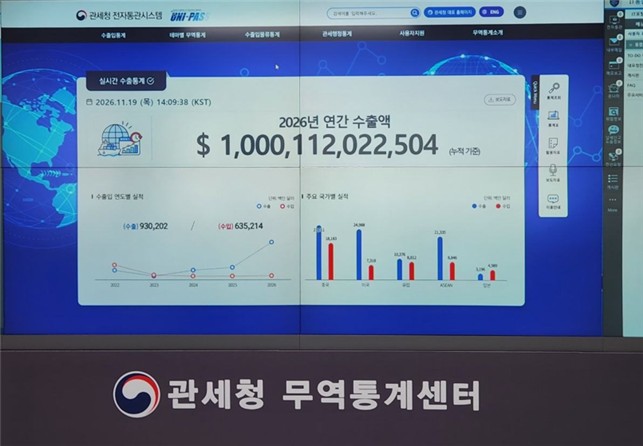
South Korea’s annual exports topped $1 trillion for the first time. As semiconductor exports surged, non-chip sectors such as consumer goods, nuclear power and defence also grew. That raised the likelihood that annual exports will move into the world’s top four.
The Ministry of Trade, Industry and Energy said a preliminary tally showed cumulative exports this year exceeded $1 trillion as of 2:09:38 p.m. on Nov. 19. South Korea is the fourth country to achieve $1 trillion in annual exports after the United States, Germany and China.
South Korea’s exports grew to about $1 trillion from $19 million in 1948 over about 80 years. Last year’s exports were $709.3 billion, close to Japan’s $738.3 billion, and this year they exceeded $1 trillion. Japan’s all-time peak annual exports were $822.6 billion in 2011.
South Korea is projected to rank fourth in the world in annual exports this year.
According to the World Trade Organization, exports in January to August this year were highest for China at $2.924 trillion, followed by the United States at $1.641 trillion, Germany at $1.259 trillion, the Netherlands at $715.0 billion and South Korea at $694.0 billion.
The Korea International Trade Association assessed that South Korea’s exports have far exceeded the Netherlands since September, making it likely to rise to fourth place globally on an annual basis.
Semiconductors led the export increase. Semiconductor exports in January to October were $396.8 billion, up 193.1 percent from a year earlier. Their share of total exports reached 42.7 percent.
Rising demand for high-bandwidth memory, or HBM, and DRAM driven by expanded artificial intelligence investment had an effect. South Korea’s global market share in HBM was tallied at 83.0 percent as of the second quarter this year, and DRAM at 65.6 percent in the first half of this year.
Exports excluding semiconductors also rose. Non-chip exports in January to October increased 20.2 percent from a year earlier. Export items broadened to include consumer goods such as K-beauty and K-food, as well as nuclear power and defence.
The improvement in the trade balance was also large. The cumulative trade surplus in January to October was $294.9 billion, more than three times the previous annual record of $95.2 billion in 2017.
Export markets and companies also diversified. Exports increased in 7 of the 9 major export regions in January to October, and exports by small and medium-sized enterprises hit a record high over the same period.
Still, rising dependence on semiconductors is cited as a task going forward.
Kwon Nam-hoon (권남훈), head of the Korea Institute for Industrial Economics and Trade, said, "Due to base effects and other factors, the pace of increase will slow somewhat next year, but we can keep the $1 trillion trend going." He added, "We need to be careful so that the competitiveness of the domestic industry overall is not damaged by inter-industry imbalances from a semiconductor concentration, macroeconomic changes such as the exchange rate, and insufficient trickle-down effects."
Trade Minister Kim Jung-kwan (김정관) said, "While discovering new growth engines, we will concentrate all the government’s capabilities so that the warmth of exports leads to revitalisation of regional economies and the creation of youth jobs."
 Oh Sang-yup
yub@d-today.co.kr
Keyword
#WTO #semiconductors #HBM #DRAM #Ministry of Trade #Industry and Energy