
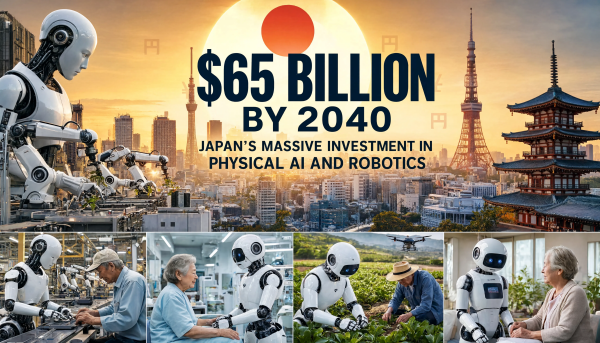
The Japanese government has unveiled a large-scale investment plan to invest a total 10.5 trillion yen, about 100 trillion won, by 2040 to foster the physical AI industry. It aims to push humanoid robots and automation in earnest as a national growth strategy to respond to labour shortages stemming from low birth rates and population ageing.
Cryptopolitan, a blockchain media outlet, reported on June 20 local time that the Japanese government plans to invest 10.5 trillion yen in physical AI through 2040 by combining public and private funds. The investment targets 17 strategic industries designated by the government.
The plan is the first large-scale implementation package since Japan elevated physical AI and humanoid robotics to core national industries. Japan's cabinet adopted a national AI basic plan last December and formally included physical AI and humanoid robots in its national strategy. As a result, R&D investment that had been centred on individual companies is expanding into a state-led programme.
Recent policy moves by the Japanese government also point in the same direction. Japan's AI Strategy Headquarters released a draft on June 19 to establish a system for the ongoing evaluation of AI-related legislation. Earlier, on June 16, the Bank of Japan raised its policy rate to 1 percent, and on the same day Japan's Ministry of Economy, Trade and Industry and the Ministry of the Environment began reviewing the introduction of a mandatory collection system for electric vehicle batteries. The Japanese Bankers Association also warned on June 18 that risks of AI-based cyber attacks are growing.
The industry assesses that Japan is moving to integrate AI investment, industrial policy, financial policy, environmental regulation and cybersecurity into a single national competitiveness strategy.
A serious population decline problem lies behind the large-scale investment. Japan is projected to see its working-age population fall by about 15 million over the next 20 years. The share of the working-age population currently stands at 59.6 percent of the total population. With the population continuing to decline since 2000, the government views automation and robotics as an essential national task rather than a matter of corporate choice.
Japan already has a world-leading robotics industry base. The International Federation of Robotics said Japan operates 419 industrial robots per 10,000 manufacturing workers. Total industrial robot installations amount to about 435,000 units. Last year Japan accounted for 38 percent of global industrial robot exports and supplied more than 160,000 units to major countries including China, the United States and Germany. Export value was estimated at about $12.5 billion.
The domestic market also continues to grow. Japan's robot orders in the first quarter of 2025 totalled 324.5 billion yen, up 14.2 percent from a year earlier, hitting a record high. In the automotive industry, about 13,000 industrial robots were newly installed last year, the highest level since 2020.
Market forecasts are also positive. Market research firms project the global physical AI market will grow from $5 billion in 2025, about 7.68 trillion won, to $82.8 billion in 2034, about 127 trillion won. Japan's market is also expected to expand over the same period from $307.3 million, about 472 billion won, to $6.8 billion, about 10.45 trillion won.
The AI industry is also focusing on growth potential in the robotics market. Jensen Huang (젠슨 황), CEO of Nvidia, said at CES 2026 of the robotics industry, "ChatGPT's moment is here now." IDC forecast that global shipments of humanoid robots will exceed 50,000 units in 2026, up 178 percent from a year earlier.
Against this backdrop, Japan's large-scale investment plan has the character of an industrial reshuffle to respond to a shrinking workforce, beyond a simple technology development policy. Key points to watch are how funds are allocated across the 17 strategic industries and whether the shift to state-led investment actually leads to expansion of semiconductors, robots and automation equipment.
 Jinju Hong
hongjj@d-today.co.kr
Jinju Hong
hongjj@d-today.co.kr