The government set the standard for exempting AI data centres (DC) from power grid impact assessments at 50 megawatts or less of contracted power. It will also specify criteria for recognising AI data centres and simplify permit and licensing procedures.
The Ministry of Science and ICT said on Thursday it would seek public comment for 40 days until Dec. 30 on draft enforcement decrees and rules for the AIDC special law that include those measures. The draft details eligible support targets and the scope of regulatory exemptions under the special law that takes effect in March next year.
It first established criteria for recognising an AIDC. Facilities that have AI accelerators such as graphics processing units (GPU) and neural processing units (NPU) above a certain scale and secure essential equipment such as power and cooling are eligible. The design power ratio must also be 1.5 or lower.
Specifically, a facility is recognised as an AIDC if AI equipment power is at least 250 kilowatts and accounts for at least 50 percent of total IT equipment power, or if AI equipment power is at least 5 megawatts. Colocation facilities that provide other operators with space to install AI servers and power and cooling equipment are also included as eligible for support.
It also overhauled reporting procedures for building and operating AIDCs. Reporting is divided into build reports, operation reports and change reports. A build report must be filed before construction starts, and an operation report must be filed by 30 days before operations begin. Any changes must be reported within 30 days.
To prevent cases in which companies secure regulatory exemptions such as waivers of power grid impact assessments with build reports alone, the rules require them to set and report a construction start date within 1 year of the filing date. The government plans to review additional legislation to block dummy operators depending on market conditions.
It will also simplify permitting and licensing. If a company applies for bundled processing of permits and licenses, the ministry must request document reviews from relevant agencies within 7 days. Relevant agencies must respond within 10 days on whether additional documents are needed. The ministry will then conduct a review within 30 days and submit the case to the National AI Strategy Committee for deliberation and approval.
Even if relevant agencies do not respond within the deadline, procedures can proceed based on the submitted documents to reduce permitting delays.
Power regulations for AIDCs outside the Seoul metropolitan area will also be eased. Among AIDCs outside the capital area that are newly built or expanded, or converted from existing facilities, those with contracted power of 50 megawatts or less will be exempt from power grid impact assessments.
For large AI data centres, the government will pursue faster procedures rather than exemptions. It plans to consult with the Ministry of Climate, Energy and Environment to introduce a fast track that prioritises power grid impact assessments for AIDCs classified as megaprojects and those subject to bundled permitting and licensing. It is also pushing a plan to exempt facilities in AIDC special zones from non-technical assessments.
Installation standards for facilities will also be eased. Considering that AIDCs have fewer onsite workers and less vehicle use than general buildings, requirements for attached parking lots will be eased by 20 percent from current levels. The easing can be expanded to as much as 50 percent depending on city and provincial ordinances.
In calculating total floor area to determine whether a building must install artworks, areas for computer rooms and cooling equipment rooms will be excluded. To curb concentration in the capital area, the computer room area will be fully excluded outside the capital area, but only half will be excluded in the capital area.
It also detailed procedures for designating AIDC special zones and the scope of support. If local governments submit business plans and plans related to power supply and demand, securing funding and resident acceptance, the ministry will review them within 90 days and designate special zones following deliberation and approval by the National AI Strategy Committee.
Support targets by the central and local governments within special zones include not only power and water supply facilities but also roads and bridges, energy storage facilities, waste heat reuse facilities, ultra-high-speed telecommunications facilities, and security and disaster response facilities.
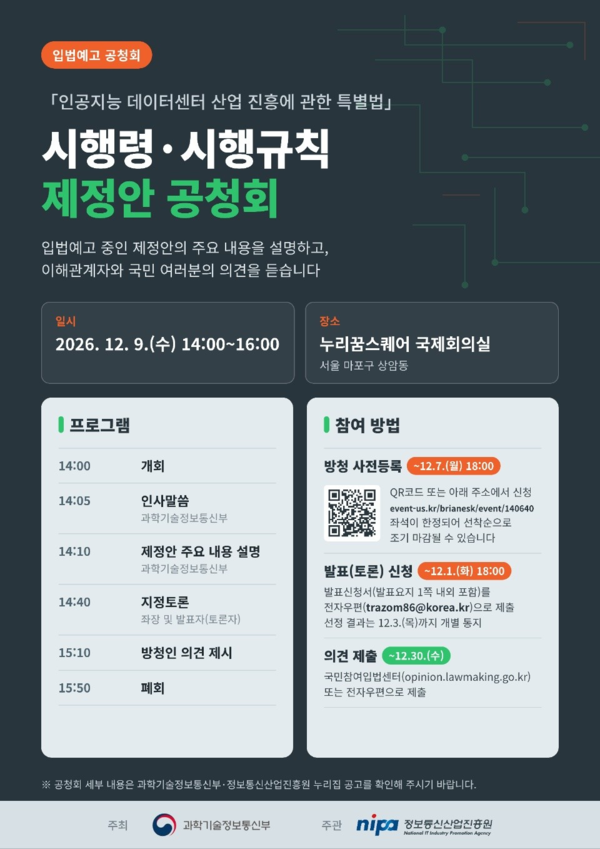
The ministry will hold a public hearing on Dec. 9 at Nuri Dream Square in Mapo district, Seoul, to gather industry views. In the first half of next year, it also plans to prepare regional coexistence guidelines that include standards and procedures for collecting views from residents living near data centres.
Bae Kyung-hoon (배경훈), deputy prime minister and minister of science and ICT, said the subordinate legislation would give operators predictability on which AIDCs will be eligible for support under the special law and what range of benefits they can receive. He said the government would faithfully gather views from the field and prepare so that AIDCs can become the foundation for growth in the AI industry.
 Jin-ho Lee
jhlee26@d-today.co.kr
Keyword
#Ministry of Science and ICT #AIDC #National AI Strategy Committee #Seoul #Nuri Dream Square