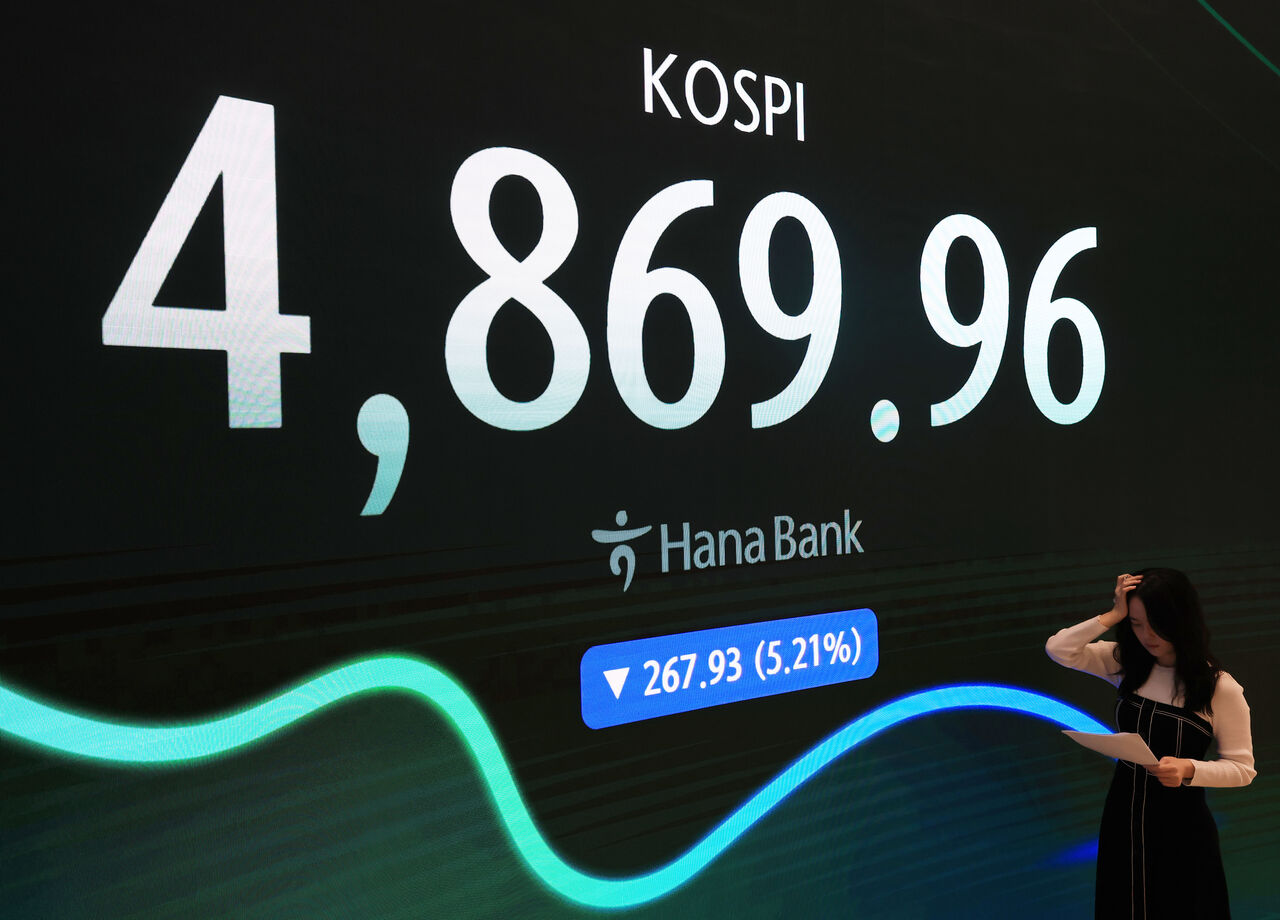
South Korean stocks fell more than 5 percent on heavy selling by foreign and institutional investors. The KOSPI slipped back below the 5,000 level after 3 sessions, while the Kosdaq also posted a decline of more than 5 percent. Sell-sidecar curbs were triggered in both markets.
On Nov. 20, the KOSPI closed at 4,869.96, down 267.93 points, or 5.21 percent, from the previous session. The index opened down 209.38 points, or 4.08 percent, at 4,928.51 and widened losses soon after the start.
By investor type, foreigners net sold 1.13 trillion won and institutions net sold 950.9 billion won. Individuals net bought 1.59 trillion won, absorbing supply.
Most of the top market-cap stocks fell, led by large semiconductor names.
Samsung Electronics closed down 7.01 percent at 183,100 won, and SK Hynix fell 5.92 percent to 1,113,000 won.
Elsewhere, K Square fell 8.39 percent. Samsung Electro-Mechanics plunged 12.54 percent to end at 774,000 won.
Hyundai Motor slipped 4.67 percent, while Samsung Biologics fell 1.45 percent, Celltrion 0.93 percent, LG Energy Solution 0.83 percent and KB Financial Group 0.33 percent.
The Kosdaq closed at 645.68, down 39.13 points, or 5.71 percent, from the previous session.
With both the KOSPI and Kosdaq falling more than 5 percent, sell-sidecar curbs that temporarily halt the effectiveness of program sell orders were triggered in each market.
In the Seoul foreign exchange market, the won-dollar exchange rate was 1,336.40 won, up 0.90 won from the previous session.
The market sees global supply-demand pressure around Anthropic's initial public offering and weaker investor sentiment toward AI and semiconductors as having affected South Korean shares as well.
Han Ji-young (한지영), a researcher at Kiwoom Securities, cited as one factor behind the day's decline the outflow of funds from existing AI and semiconductor shares due to demand to buy the stock after Anthropic's IPO.
He also assessed that investor sentiment was pressured because existing uncertainties have not been fully resolved, including individual negative factors surrounding U.S. semiconductor shares, concerns about a shrinking AI investment cycle and data center regulations.
Han explained that recent sharp swings over a short period have weakened confidence in market lows, and there is no clear buying force to absorb foreigners' net selling.
He said worsening supply-demand conditions were continuing, citing "a disappearance of buying forces to the extent they cannot absorb foreigners' net selling." He said there is a need to guard against the possibility that market instability could widen in the short term.
 Oh Sang-yup
yub@d-today.co.kr
Keyword
#KOSPI #Kosdaq #Samsung Electronics #SK Hynix #Anthropic