
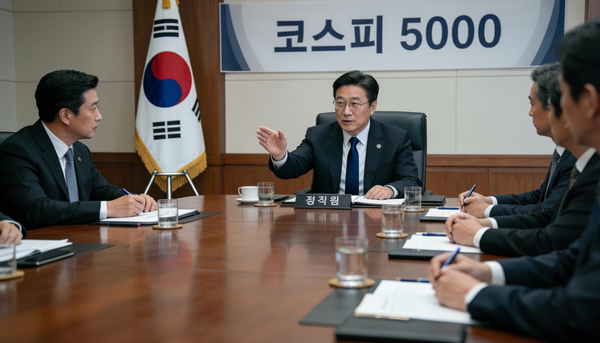
South Korea's KOSPI extends gains for 10 straight sessions, starting a countdown to the 5,000 era. The government is also throwing its full support behind the market, unveiling a revamped Individual Savings Account (ISA) plan with sweeping tax benefits to encourage long-term investing and significantly tightening surveillance for stock manipulation.
On Jan. 15, the KOSPI closed up 74.45 points, or 1.58 percent, at 4,797.55 from the previous session. The 10-session winning streak is a highly unusual record. Foreigners posted net purchases of 334.4 billion won in the main board market, while institutions bought a net 1.3 trillion won, helping drive the index higher.
Top market-cap stocks also rose across the board. Semiconductor leaders Samsung Electronics, up 2.57 percent, and SK Hynix, up 0.94 percent, extended gains. Auto stocks such as Hyundai Motor, up 2.55 percent, and Kia, up 6.64 percent, also advanced, along with defence and shipbuilding-related shares such as HD Hyundai Heavy Industries, up 2.60 percent, and Hanwha Aerospace, up 1.97 percent.
As the KOSPI 5,000 era comes into view, the government appears to be accelerating efforts to revitalise domestic investment. Under the '2026 Economic Growth Strategy' announced on Jan. 9, the new ISA is divided into two types, a 'Youth ISA' and a 'National Growth ISA', depending on eligibility and benefits.
The Youth ISA targets young workers who urgently need to build assets. Young people aged 19 to 34 with total annual pay of 75 million won or less can sign up. It offers tax exemptions on interest and dividend income and newly introduces an income deduction benefit on paid-in principal.
The National Growth ISA targets all citizens and broadens tax benefits to encourage long-term investment. Under the existing ISA, interest and dividend income is tax-free only up to 2 million won (4 million won for the low-income type) if maintained for at least 3 years, while any excess is subject to separate taxation at 9.9 percent. For the National Growth ISA, authorities are reviewing options to sharply raise the ceiling or abolish it altogether.
The government also plans to create a 600 billion won 'Public Participation Fund' to offer income deductions and preferential separate taxation on dividend income for long-term investors. If losses occur, public finances will bear losses on a subordinated basis to strengthen investment safeguards.
Surveillance and penalties for unfair trading will also be strengthened further. The Financial Services Commission, the Financial Supervisory Service and the Korea Exchange said on Jan. 14 they will expand and reorganise the 'Joint Response Team to Eradicate Stock Price Manipulation' from one team to a two-team system.
With the overhaul, headcount at the joint team will increase to 62 from 37. All personnel from the FSC's Capital Market Investigation Division and additional staff from the FSS investigation bureau will be added, and the government plans to further expand staffing through a future restructuring of related organisations.
The response unit will be split into Team 1 and Team 2 to competitively investigate unfair trading cases. FSC personnel with compulsory investigation powers, including search and seizure, and FSS personnel with extensive investigative experience will work closely together to ensure swift and strict law enforcement.
The government plans to use the measures to detect early and severely punish unfair trading such as price manipulation, which is becoming increasingly sophisticated and organised, and to lay the groundwork for easing the 'Korea discount'.
Behind the sweeping measures is a sense of crisis that an overseas shift among retail investors is serious. The presidential office held a closed-door meeting on Jan. 13 after convening CEOs of major brokerages and asset managers.
Participants reportedly diagnosed why investors are turning to overseas markets even as KOSPI returns outpace those of U.S. stocks, and held intensive discussions on ways to bring their money back to the domestic market.
An industry official said, "The government is rolling out various incentives such as tax benefits, but there is still a strong preference for overseas investment," adding, "This meeting appears to reflect an intention to devise more effective measures through direct communication with the market."
 Oh Sangyup
yub@d-today.co.kr
Oh Sangyup
yub@d-today.co.kr