
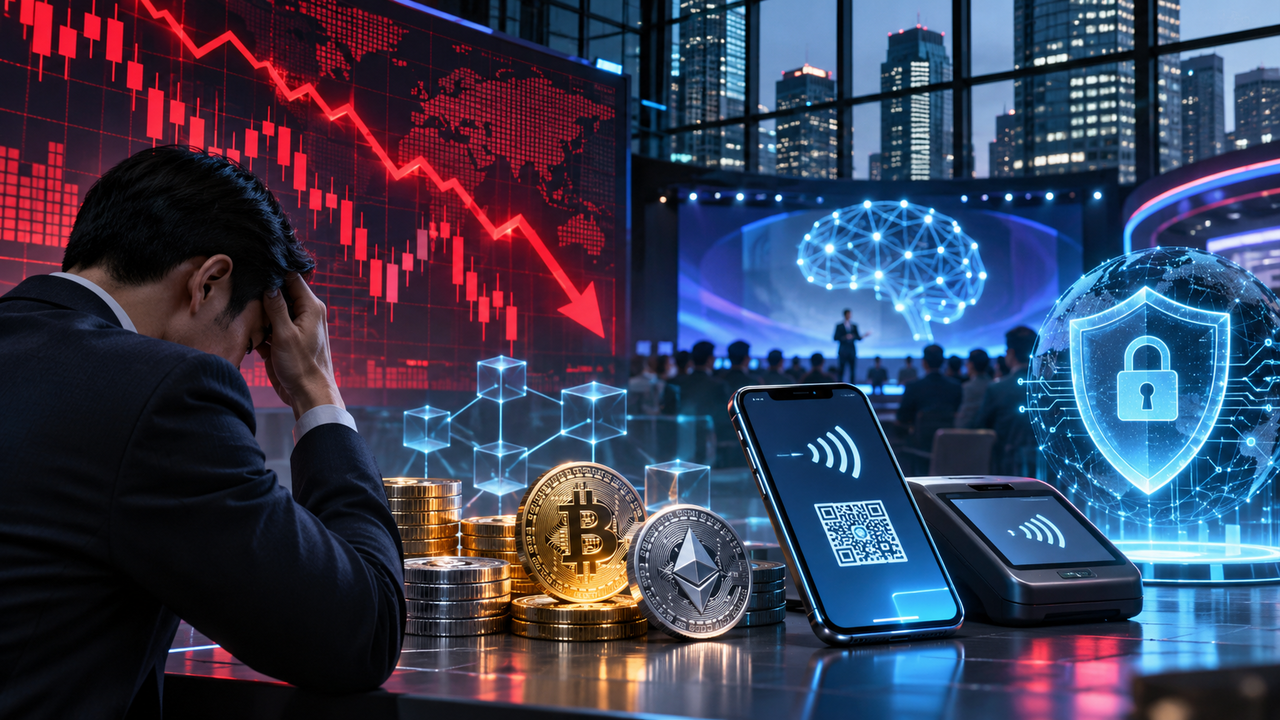
South Korea's stock market is sliding as weakness in global technology shares, interest-rate uncertainty and foreign selling combine to drag it lower. The KOSPI has fallen below the 5,000 mark, and the KOSDAQ has dropped more than 5 percent. Sell-side circuit breakers were triggered in both markets, further denting investor sentiment.
Technology-share sentiment failed to recover despite a record initial public offering by U.S. AI company Anthropic. Concerns have grown over profitability in the AI industry and an expansion in investment. Uncertainty over U.S. Federal Reserve interest-rate policy has also weighed on stocks.
As market volatility and rate jitters increase, balances in money market funds (MMF), a short-term parking place for cash, are nearing 300 trillion won.
The government held an emergency meeting on market conditions on the 22nd and began preparations to immediately activate a stock market stabilisation fund if needed. The market is citing upcoming U.S. inflation data, the Bank of Korea's Monetary Policy Board rate decision and whether foreign selling eases as key variables for a rebound.
• Fear of 'Black Monday'... government begins preparations to activate the market stabilisation fund • [Market outlook] KOSPI breaks below even 5,000... rates and foreign flows are key • KOSPI and KOSDAQ trigger sell-side circuit breakers... Samsung Electronics and SK hynix plunge more than 6 percent • U.S. Fed shows internal differences over holding rates in October... focus on whether it raises in December • Tech shares stay cold despite record Anthropic IPO • MMF nears 300 trillion won amid stock and rate jitters... corporate funds flowed in
Even as global financial markets showed an uneasy trend, moves to discuss the future of the financial industry also continued.
At the Singapore FinTech Festival (SFF 2026) held in Singapore from Nov. 18 to 20, AI agent-based financial transactions, stablecoins and a reshaping of global payment networks emerged as key topics.
Global financial firms presented a future in which AI carries out financial transactions such as payments and remittances in place of people. Hyundai Card and JPMorgan demonstrated financial transaction technology using AI agents. Visa unveiled plans to expand AI payments and its stablecoin business, and also mentioned the possibility of entering the South Korean market.
Some also pointed out that for AI financial transactions to spread, trust must be secured and clear standards are needed on transaction authority and responsibility. Eun-mi Lee (이은미), chief executive of Toss Bank, also stressed that building trust is more important than technological development.
South Korean financial and fintech firms also continued efforts to expand overseas. KB Financial reviewed AI innovation cases at global financial companies. The Korea Fintech Industry Association, Seoul Fintech Lab and the city of Incheon supported overseas expansion by South Korean fintech firms through a joint booth.
Hecto Group showcased affiliate technologies including wallets, payments and settlement, and about 2,000 people took part in a digital asset wallet experience over three days. Global investors, while wary of capital crowding into AI, focused on stablecoins, financial inclusion and blockchain-based financial infrastructure as new investment opportunities.
• [SFF2026] Toss Bank CEO Eun-mi Lee: "Can we entrust home and car purchases to AI... authority and responsibility must be clear" • [SFF2026] Global investors wary of AI crowding... focus on stablecoins and inclusive finance • [SFF2026] Hecto Group draws crowds to wallet experience... about 2,000 participants over 3 days • [SFF2026] From super wallets to AI and blockchain... South Korean fintech group heats up Singapore • [SFF2026] Hecto targets global market in Singapore with wallets, payments, KYC and K-healthcare • [Exclusive][SSF2026] Hyung-ju Park (박형주), head at KB Financial: "I leave with valuable inspiration"... feels AI finance innovation at SFF • [SFF2026] Hyundai Card and JPMorgan demonstrate AI agent transactions... "The key is control and trust" • [SFF2026] Visa expands AI payments and stablecoin business... "Preparing to enter the South Korean market" • [SFF2026] Fintech festival opens... AI finance innovation and reshaping international payment networks in focus • Hecto Group runs integrated booth at SFF 2026... stresses fintech ecosystem strategy based on affiliate cooperation
While the global financial industry is accelerating payment innovation using digital assets such as stablecoins, crypto trading markets are showing a deepening slump amid sharp price falls and shrinking activity. Bitcoin has dropped to about half its peak from last year, and heavy losses have occurred in digital-asset related shares and leveraged exchange-traded funds (ETFs).
The downturn has led to worsening results at South Korean crypto exchanges. Dunamu, which operates Upbit, posted third-quarter revenue of 151.7 billion won, down 60.7 percent from a year earlier. Bithumb reported 59.4 billion won, down 69.7 percent. Both turned to operating losses, and combined customer won deposits at the two exchanges fell by a total of 2.51 trillion won from the start of the year through the end of the third quarter.
The exchanges are moving to diversify their businesses to secure new revenue sources. Dunamu is pursuing ways to link finance and payments with digital asset businesses through a corporate combination with Naver Financial. Bithumb is expanding into gold and precious metals distribution and a real estate platform. Upbit's installment-style investment service, "Coin Collecting", has surpassed 1 trillion won in cumulative investment.
Swiss banks are also urging regulatory revisions to secure competitiveness in the country's stablecoin industry, as moves continue to pre-empt new financial infrastructure despite the slump in digital assets markets.
• Digital asset exchanges, can diversification help them get through 'crypto winter'? • Fear of losing the initiative in stablecoins... Swiss banking sector urges regulatory overhaul • Upbit's "Coin Collecting" tops 1 trillion won in cumulative investment since launch • Digital asset shares cry out as bitcoin halves... leveraged ETF loss rate up 90 percent • Upbit and Bithumb deposits down 2.5 trillion won... value of held digital assets also falls • Bithumb third-quarter revenue 59.4 billion won... down 69.7 percent on year • Dunamu third-quarter revenue 151.7 billion won... down 60.7 percent on year
In the digital asset industry, security issues driven by a series of hacks and data leaks remain a key concern regardless of the market slump. After incidents at major South Korean exchanges Bithumb and Gopax, Coinone also suffered a personal data leak, meaning three of the five won-based exchanges have experienced security breaches.
Financial authorities demanded that digital asset exchanges establish security systems at the same level as existing financial companies such as banks. The Financial Supervisory Service convened exchanges' chief information security officers and ordered a full re-check of external contact points and IT vulnerabilities. It warned it would strictly hold them accountable if an incident occurs while vulnerabilities are left unaddressed. It also presented 24-hour security monitoring, expanded cold-wallet storage, and larger insurance coverage and reserves as key improvement tasks.
An incident also occurred in the securities industry. Unusual withdrawals were detected from a local bank account in the name of KB Securities' Vietnam unit, and local police and financial authorities began an investigation. Overseas, the German banking sector is also moving toward joint responses to financial crime, including building a shared security platform to share fraud-related information among financial companies.
• FSS issues security warning to digital asset industry: "Strict response if incidents occur with vulnerabilities left unaddressed" • Unusual withdrawals from KB Securities Vietnam unit account... local authorities begin investigation • Digital asset exchange hacking leaves them helpless... will pressure for bank-level security work? • Catch fraud by sharing bank information... German financial sector builds joint security platform
As financial security has emerged as a key task, banks and brokerages are also accelerating work innovation using AI. AI use is expanding beyond automation of simple tasks into financial information analysis, product searches and program development.
Mirae Asset Securities began full operations of a service that integrates searches of financial products, corporate information and disclosure and research materials using Amazon Web Services' generative AI technology. IBK Industrial Bank of Korea built an AI coding agent called "JeniCode" on its internal network so employees can write code in natural language and develop work programs.
WebCash began a pilot project with Hana Bank to apply AI analysis functions to corporate cash management services. The model analyses cash status and transaction information and even prepares reports when corporate clients ask questions in natural language. Dunamu publicised research achievements after three papers combining AI and blockchain were accepted at an international financial AI conference.
Interest is also growing in how advanced technologies could affect competitive dynamics in the financial industry, including expectations that advances in quantum computing could change existing banks' competitiveness in risk analysis and pricing.
• Mirae Asset Securities begins full operation of AWS-based 'financial product knowledge AI search' • Dunamu has three papers accepted at an international financial AI conference • IBK Industrial Bank of Korea introduces internal-network AI coding agent... expands on-the-job AX • Will quantum computing change finance? Will banks' 'risk analysis monopoly' be shaken? • WebCash supplies AI to Hana Bank corporate cash management... verifies financial information analysis
Digital innovation in finance is also continuing in payments and cross-border remittances. Global payments companies are linking national payment networks to improve convenience for cross-border transactions, and South Korean financial and fintech firms are moving to expand new payment technologies and services.
Visa agreed to expand QR payment networks in the Asia-Pacific region in cooperation with Ant International's Alipay+. Hecto Financial is also strengthening cooperation with global payments network company Thunes and is pursuing ways to link payment rails in more than 140 countries to South Korea's payment and settlement infrastructure. Toss Bank completed a proof of concept for overseas remittances using the Solana Foundation and the dollar stablecoin USDC, and confirmed it was processed within tens of seconds from request to arrival in the recipient's wallet.
In South Korea, the scope of easy-payment services is also widening. KakaoBank began supporting mobile payments for users of its debit card and youth Mini card after introducing Apple Pay. Naver Pay provided payments and facial recognition-based entry services at the K-Bakery Festival, expanding the use of offline payment infrastructure. KG Financial's mobile-payment-based prepaid card "Mobil Card" has broadened its user base, surpassing 3 trillion won in cumulative transaction volume and securing 780,000 subscribers.
• Visa teams up with Alipay+ to expand overseas QR payment networks • Hecto Financial expands global payments and remittance cooperation with Thunes... pushes link-up with payment rails in 140 countries • Naver Pay provides payments and facial recognition infrastructure at 'K-Bakery Festival' • KakaoBank introduces Apple Pay... supports debit card payments • KG Financial's Mobil Card tops 3 trillion won in cumulative transactions... 780,000 subscribers • Toss Bank completes stablecoin remittance test... confirms transfer within tens of seconds
Elsewhere, various moves continued in the finance and fintech sector, including new financial product launches, expanded customer services and overseas expansion.
KB Kookmin Bank launched a foreign-currency deposit product whose return is determined by fluctuations in the U.S. S&P 500 index. It guarantees the principal in dollars if held to maturity. Shinhan Bank expanded dining-out benefits for Nara Sarang Card customers through a partnership with Lotte GRS, and Hana Bank prepared an event for college entrance exam takers that offers gifts and gift certificates when opening an account. iM Bank opened its first branch in Jeju and introduced a special savings product offering an interest rate of up to 11 percent per year.
KakaoBank secured a 15 percent stake in a Mongolian digital bank, becoming its second-largest shareholder. Toss launched a telecom bill management service that analyses usage information from the three telecom carriers and recommends suitable plans to customers.
Attention also focused on fintech earnings and initial public offering trends. Kookon recorded third-quarter revenue of 20.3 billion won, and quarterly revenue in its payment segment exceeded 10 billion won for the first time. By contrast, remittance-focused fintech Hanpass faced a sharp post-listing share slump and deteriorating profitability, raising concerns it could weigh on IPOs by latecomer fintech companies.
• KB Kookmin Bank launches S&P 500-linked foreign-currency deposit... guarantees dollar principal at maturity • Shinhan Bank partners with Lotte GRS... expands dining benefits for Nara Sarang Card customers • Hana Bank supports exam takers' financial life... offers gifts and gift certificates when opening accounts • iM Bank opens first Jeju branch... launches special savings product with 11 percent annual interest • KakaoBank secures 15 percent stake in Mongolian digital bank... becomes second-largest shareholder • Toss launches telecom bill management service... "analyses usage data from the three carriers to recommend plans" • Kookon third-quarter revenue 20.3 billion won... payments segment tops 10 billion won for first time • Hanpass shares plunge after listing and profitability worsens... impact on latecomer fintech IPOs?
 Ji-young Lee (이지영)
ljy@d-today.co.kr
Keyword
#KOSPI #KOSDAQ #Singapore FinTech Festival #Stablecoin #Bitcoin
