
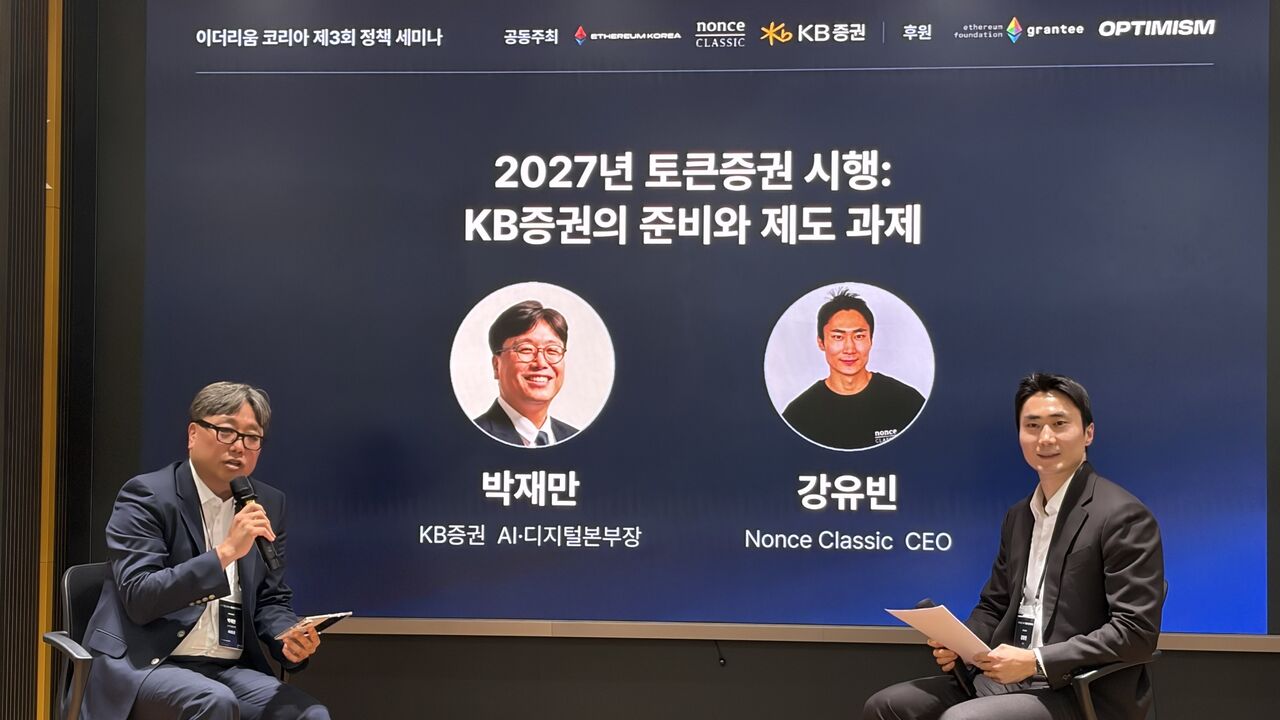
KB Securities is preparing initial products such as money market funds (MMFs) and bonds by referencing the U.S. market ahead of the introduction of the token securities (STO) system in February. It is also building multichain-based infrastructure that can later connect to public blockchains.
Park Jae-man (박재만), an executive director at KB Securities, said at an STO policy seminar held on Nov. 23 at the company's headquarters in Yeouido, Seoul, that experiencing and learning in advance what will happen in Korea by looking at the U.S. market is very important.
KB Securities is focusing on MMFs as an initial product area. Park cited immediate liquidity as one of the key benefits of token securities. "We see the money market as one of the important products for immediate liquidity," he said, adding that the company is preparing the product both in Korea and overseas.
KB Securities is also preparing for situations in which blockchain infrastructure differs between domestic and overseas markets.
Park said he is closely examining what problems operators actually faced in the U.S. market and how they solved them to create revenue models.
He said the company is preparing a multichain structure that does not rely on a single chain because the currently permitted infrastructure in Korea differs from blockchains used in overseas markets.
"Looking at cases in other countries, we see that it will naturally move from private to public, and we expect infrastructure diversity to broaden further," Park said. "We are building the architecture and preparing engineers so there are no problems even if other infrastructure, including Ethereum, participates," he added.
KB Securities said it recently completed work to add new blockchain infrastructure to its existing infrastructure in about 2 to 3 weeks. It is building an issuance and distribution platform that is not dependent on any specific blockchain and can connect to new networks as needed.
Park also emphasised the role of artificial intelligence (AI) in the token securities business. He said the company initially approached AI as a way to improve efficiency in token securities development, but concluded during system construction that AI is an essential technology rather than an option.
He said advanced software design is needed to apply an existing securities firm's business processes and data, interfaces among multiple systems, and complex logic to smart contracts.
"I am now thinking whether it is possible to properly implement token securities without AI capabilities," Park said. "Creating token securities anew from existing legacy systems requires top-level software architecture capabilities," he added. He said generative AI such as Claude, Gemini and GPT can be used in the development process.
He cited 24-hour operations and automated settlement systems as issues the industry must verify together.
He said that because multiple securities firms and infrastructure providers must operate by linking the same system in the token securities market, problems could arise that are difficult for a single securities firm to solve alone.
"It is something we need to do together with partners in the same consortium and fellow securities firms," Park said. "It will be an interesting challenge to solve experiences we have never tried before together," he added.
Still, KB Securities does not expect it will be easy to see major success cases immediately in 2027, the first year of the system's implementation.
It said the market will start with relatively limited products such as private bonds and private MMFs for institutional investors, so time will be needed before investors can feel immediate liquidity and settlement efficiency from tokenisation.
"I do not think there will be big success cases next year," Park said. "In about 2 years, at this stage, we can verify that immediate deposits and settlement and 24-hour operation work well, and if we move to public bonds and securities in stage two, then I think explosive success cases can emerge," he added.
 Oh Sang-yup
yub@d-today.co.kr
Keyword
#KB Securities #STO #MMF #Ethereum #AI
