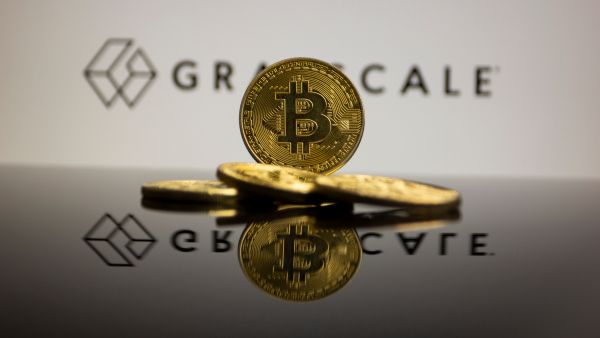
A view has emerged that as bitcoin’s price volatility has eased, institutional investors should revisit their existing risk assessment methods.
CoinPost, a blockchain media outlet, reported on Thursday that asset manager Grayscale said in its report, "Beyond Volatility: Rethinking Crypto Risk," that it is difficult to evaluate today’s bitcoin by the same standards as 10 years ago.
In the early bitcoin market, price volatility often exceeded 100 percent and at times neared 200 percent. As market size and liquidity expanded and institutional participation and the introduction of exchange-traded products (ETPs) followed, realised volatility fell to about 43 percent. That is lower than about 19 percent among S&P 500 constituents.
Grayscale said bitcoin remains a volatile asset, but cryptocurrencies should not all be grouped and assessed as the same high-risk asset. It said investors should look not only at an asset’s price swings but also when returns occur and how it relates to existing investment assets.
Lower volatility does not mean sharp price moves have disappeared. Bitcoin tends to post more frequent extreme rises and falls than stocks. Its annualised return over the past three years was about 60 percent, but it fell to 7 percent excluding the 10 days with the biggest gains. By contrast, excluding the 10 days with the biggest declines, it rose to 197 percent. That is why there is a view that investors can sell to avoid a sharp drop and miss a subsequent rebound.
At the portfolio level, it pointed to diversification potential. JP Morgan Asset Management’s 2027 long-term capital market outlook estimated bitcoin’s average annual return over the next 10 years at 10 percent, annualised volatility at 55 percent and correlation with U.S. large-cap stocks at 33 percent.
Based on an analysis applying past returns, Grayscale said a small bitcoin allocation in institutional portfolios improved annualised returns and the Sharpe ratio, a measure of risk-adjusted return. Overall portfolio volatility and maximum drawdown rose only slightly.
The cryptocurrency market has also become harder to explain through bitcoin alone. Over the past three years, about half of the variation in sector-by-sector cryptocurrency returns could be explained by bitcoin. Over the past two years, excluding stablecoins, six assets took turns leading quarterly returns among the top 10 assets by market capitalisation, and bitcoin did not rank first even once.
Grayscale stressed that a decline in bitcoin volatility cannot be viewed as the same as reduced risk. It said institutional investors should consider not only how much prices move, but also when sharp moves occur and what impact those moves have on existing portfolios.
 Yoonseo Lee
yslee@d-today.co.kr
Keyword
#Grayscale #Bitcoin #S&P 500 #JP Morgan Asset Management #ETP