
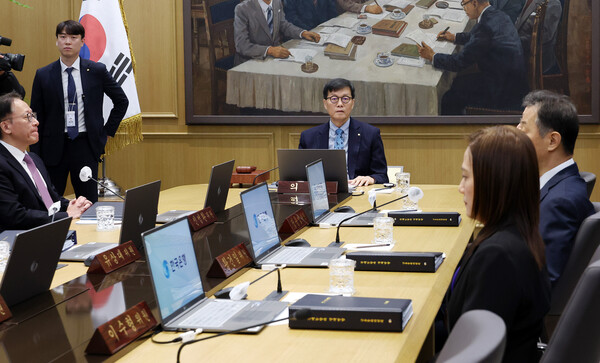
The Bank of Korea's Monetary Policy Board held the base rate at an annual 2.50 percent.
The board said on Jan. 15 it decided to keep rates unchanged after considering expectations that inflation will gradually stabilise, the ongoing improvement in growth and persistent financial stability risks.
The board forecast the global economy to continue a modest growth trend as expansionary fiscal policies in major countries and ongoing AI investment offset the impact of U.S. tariff policy.
It assessed that the domestic economy continued to improve on a recovery in consumption and rising exports despite weak construction investment. It analysed that employment is increasing, led by the services sector.
It said this year's growth rate is broadly in line with the November forecast of 1.8 percent, while upside risks have increased somewhat due to factors including a semiconductor upturn.
The consumer inflation rate edged down to 2.3 percent in December, while core inflation stayed around 2.0 percent. Inflation is expected to gradually fall to around 2 percent as international oil prices stabilise, but the rise in the exchange rate was cited as an upside risk.
It also analysed that in financial and foreign exchange markets, the won-dollar exchange rate rose back into the mid-to-high 1,400s and Treasury bond yields showed volatility as expectations of rate cuts weakened.
Household loan growth has slowed, but Seoul metropolitan area home prices are still seeing a steep rise, it said.
The board said it will run monetary policy while closely monitoring future trends in growth and prices, and the state of financial stability.
 Ji-young Lee
ljy@d-today.co.kr
Ji-young Lee
ljy@d-today.co.kr