
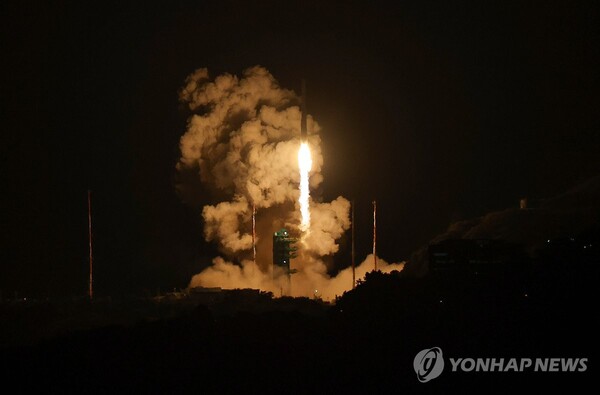
The Korea AeroSpace Administration and the Korea Aerospace Research Institute said by Dec. 2 they had made contact with nine of the twelve cubesats launched on the fourth Nuriho mission.
Nuriho lifted off on Nov. 27 carrying the third next-generation medium satellite and twelve cubesats as secondary payloads. All thirteen satellites reached a 600 km orbit.
According to the institute, contact was made on the launch day with five satellites: ETRISat from the Electronics and Telecommunications Research Institute, JACK-3 and JACK-4 from CosmoWorks, InhaROSAT from Inha University and K-Hero from the Korea Advanced Institute of Science and Technology.
Most satellite functions are being checked. ETRISat confirmed normal status through power from its solar antenna.
On Nov. 28, first contact was made with three satellites: Spiron from Sejong University, Cosmic from WoozuroTech and Sejong-4 from Hancom InSpace.
On Nov. 29, SNUgLite-3 from Seoul National University established its first two-way communication and is undergoing functional checks.
Three satellites have not made first contact: EEE Tester-1 from the Korea Aerospace Research Institute, PERSAT from Quaternion and B-1000 from SpaceLyntech.
The agency said it plans to continue attempts using precise orbital data from the U.S. Combined Space Operations Center.
Cubesats are smaller than large satellites and cannot carry high-performance components. Their success rate is not high, and it can take a week to confirm communication results.
The agency said contacted secondary payloads confirm survival and basic condition during initial communication. They will move to early operation to verify that all systems function normally before starting full missions.
Park Jaesung, head of space transportation at the agency, said cubesats stand at the forefront of space technology, advancing through repeated failures and successes. He said the agency will work to provide diverse and stable launch opportunities so private-sector ideas can reach space.
[Yonhap]
 Online Team
d-today@d-today.co.kr
Online Team
d-today@d-today.co.kr