
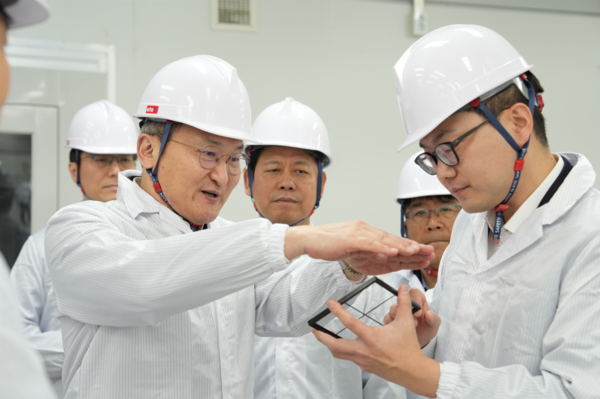
SK On has solved a key hurdle to commercialising silicon anode all-solid-state batteries by developing a new material binder with Yonsei University. SK On said on Wednesday it developed a new binder, PPMA, optimised for silicon anodes with teams led by Yonsei University professors Yoonseok Jung and Junghoon Kim. PPMA is an electronic conductive polymer that secures conductivity and adhesion at the same time. It can address structural safety problems in existing silicon anode all-solid-state batteries.
The study succeeded in operating silicon anode all-solid-state batteries using the new binder under pressure conditions close to commercialisation. It verified performance in high-energy-density pouch-type batteries under conditions for actual electric vehicle use, beyond the laboratory level. SK On stressed that the batteries maintained initial performance without capacity decline even after hundreds of charge and discharge tests.
Silicon anodes are seen as a core material for next-generation high-energy-density batteries because their theoretical storage capacity is about 10 times that of graphite. But a key commercialisation challenge has been that their volume changes by more than 300 percent during charge and discharge. When expansion and contraction break contact between particles and increase internal resistance, it becomes difficult to deliver battery performance including energy density and capacity as well as lifespan, output and efficiency.
Because electricity flows only through contact between solid particles in electrodes in all-solid-state batteries, broken contact is difficult to recover. As a result, approaches have included increasing the use of a binder, an adhesive material, or applying high pressure. PVDF, used as an existing binder material, is highly insulating, making it hard to improve electrode performance as its use increases.
Researchers at SK On and Yonsei University found that performance degradation in low-pressure environments stems from electron movement inside the electrode rather than lithium-ion transfer. PPMA is designed to stably form pathways for electrons across the electrode while strengthening bonding of silicon particles. The company explained that it enables a water-based process, reducing environmental burden, cutting manufacturing costs and lowering pressure by more than 80 percent.
Park Ki-soo, head of SK On's Future Technology Institute, said, "We made meaningful progress in the next-generation all-solid-state battery field through industry-academia cooperation." He added, "We will continue to accelerate innovation in next-generation battery technologies together with academia."
The findings were published in the international journal Nature Communications on Dec. 5 last year. SK On produced research results in the silicon anode field after disclosing research achievements on single-crystal cathode materials with Seoul National University on Jan. 8. SK On completed an all-solid-state battery pilot plant of about 4,628 square metres at its Future Technology Institute in Daejeon in the second half of 2025. Its target time for commercialising all-solid-state batteries is 2029.
 Daegeon Seok
d2dg@d-today.co.kr
Daegeon Seok
d2dg@d-today.co.kr