
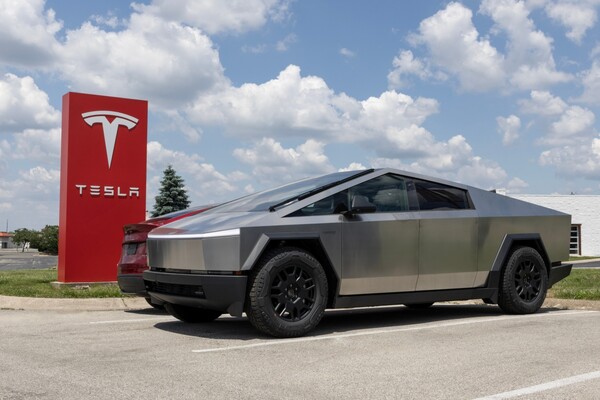
[DigitalToday reporter Jinju Hong] Criticism has emerged that Tesla has failed to produce a clear example of a successful new product after the Cybertruck’s poor performance. Tesla, which once reshaped the electric vehicle market with the Model S, Model 3 and Model Y, is now judged to be delivering new-model results that fall short of expectations. Some analysts also say product development competitiveness weakened after co-founder and former chief technology officer JB Straubel (스트라우벨) left the company.
On Nov. 8 local time, electric-vehicle outlet Cleantechnica said Tesla has struggled to introduce successful new products since Straubel stepped down as CTO in 2019. It cited the Cybertruck as a prime example.
The Cybertruck was expected to shake up the U.S. pickup truck market ahead of its launch, backed by large-scale reservation demand. Tesla built production facilities with capacity of 125,000 vehicles a year. It also set a long-term goal of expanding output to 250,000 vehicles a year and up to 500,000.
Actual sales fell short of expectations. Cleantechnica cited a post on X, formerly Twitter, saying that while the Cybertruck has annual production capacity of 125,000 vehicles, sales totalled about 70,000 over three years after launch. The post claimed that despite spending $2 billion on research and development, gross profit was only $100 million, resulting in losses of about $1.9 billion on the project. The outlet said not all of the figures were verified, but judged it clear there was a large gap between the original production targets and actual sales.
The outlet also said the Cybertruck’s reservation demand was hard to view as an indicator of real sales potential. Reservations before launch required a $100 payment and could be cancelled and refunded. Even with a large number of reservations, it was unclear how much they reflected actual intent to buy.
Cleantechnica compared the Cybertruck’s weak performance with past Tesla new models. The Model S was seen as a premium electric car that could compete with the BMW 7 Series and Mercedes-Benz S-Class, and the Model X expanded into the large SUV market. The Model 3 was a major hit that led the mass adoption of electric cars, and the Model Y, developed on that base, broadened the consumer base in a crossover format. The Model Y later became the world’s best-selling car over several years.
The outlet focused on Straubel’s role in that product development flow. He stepped down as CTO in July 2019. It analysed that the Model Y, unveiled in March that year, shared a significant portion of parts with the Model 3 and could have been among the last major projects in which Straubel was deeply involved.
Deliveries of the Model Y began in January 2020, less than a year after it was unveiled. The Cybertruck, by contrast, was unveiled in November 2019 but took more than four years before actual customer deliveries. Cleantechnica compared the two vehicles’ development and launch processes and raised questions about Tesla’s speed and execution in developing new products after Straubel’s exit.
It also pointed to limited new vehicle choices after Straubel’s departure. Beyond the Cybertruck, there were few major new products capable of changing the market landscape, and development of smaller, cheaper consumer vehicles did not show clear progress, it said. Tesla launched an entry-level model that simplified the existing Model 3, but it was hard to see it as a completely new vehicle type.
In the energy business, Straubel’s departure also coincided with the product-launch timeline. Tesla’s large energy storage system, the Megapack, was launched in July 2019 when he stepped down as CTO. Performance improvements and partial changes to electric vehicles and energy storage systems continued, but the outlet said Tesla’s ability to deliver new products that could draw market attention had weakened compared with the past.
Cleantechnica also raised the possibility that Straubel played a practical role in turning Elon Musk (머스크), Tesla’s chief executive, ideas into realistic product development plans. It added that the two men’s actual working relationship, Straubel’s internal influence and the background to his departure were hard to confirm from outside. At the time, Tesla said Straubel stepped down as CTO to focus on battery recycling company Redwood Materials.
Tesla’s next test is now the Cybercab. Tesla has unveiled the Cybercab, a dedicated self-driving vehicle, and moved it into the production stage. It remains to be seen how much demand it can secure in the market and whether it can prove its business viability.
 Jinju Hong
hongjj@d-today.co.kr