
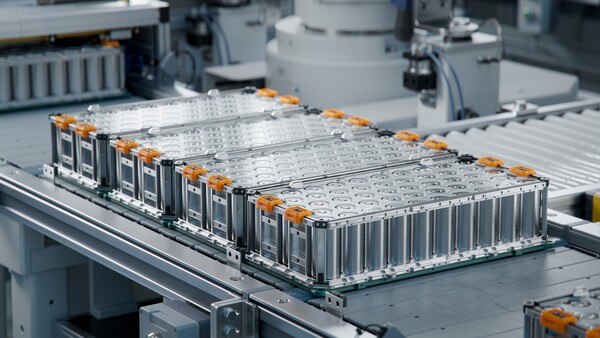
An experimental technology that pushes an electric vehicle (EV) battery pack out of a vehicle when a fire breaks out in the battery was unveiled in China.
On Nov. 8 (local time), IT media outlet Engadget reported that a system under development by Chinese researchers separates the battery pack to the side of the vehicle body in about 1 second when the battery management system (BMS) detects signs of fire, moving it away from the vehicle.
Test footage released online shows the battery pack shooting out from beneath an SUV, then sliding along the ground before coming to a stop. The prototype uses a gas generator, similar to a device that inflates airbags, to push the battery pack out. The separated pack is designed to stop about 10 to 20 feet away from the vehicle.
The technology is still at an early stage of development. Even if the battery is separated from the vehicle, it could still fall near other vehicles or pedestrians. A project official told Chinese media outlet Yipeng that the equipment began as research into side-loading battery swapping. The official said it was designed not to operate in dense urban areas where pedestrians and vehicles mix. But Chinese tech media outlet 36Kr reported that software to distinguish such areas and limit operation has not yet been developed.
Questions have also been raised about who developed the technology. The online video introduced the 'China Collision Repair Technology Center' and Shanghai-listed auto parts maker Joyson Electronics as joint developers. However, Joyson told E-Kai media outlet that it has not cooperated with the center or signed a joint development agreement. Chery affiliate brand iCar, whose 03 model the test vehicle resembles, also said it was unrelated to the demonstration. E-Kai said it could not find business registration records for the center, and a source said the organisation belongs to auto maintenance and aftermarket company Myte Group.
The attention on the technology comes amid concerns over thermal runaway in lithium-ion batteries. According to UL, a battery cell in thermal runaway can rise by more than 20 degrees Celsius per minute and exceed 300 degrees. Gas, smoke and flames are released during the process. The U.S. National Transportation Safety Board (NTSB) investigated 4 Tesla vehicle fires in 2020, including a case in Florida in which a Model S battery reignited twice. The battery caught fire repeatedly even after firefighters extinguished it, and one fire was reported to have used more than 20,000 gallons of water.
A fire test of 18 EVs published in August 2026 by UL's Fire Safety Research Institute (FSRI) also found no firefighting method that could stop thermal runaway once it began. As a result, moving a dangerous battery pack away from occupants and its surroundings is drawing attention as a response that does not rely solely on extinguishing the fire.
Automakers are also reviewing similar technology. Stellantis' U.S. unit filed a patent for a battery separation system operated by a switch inside the vehicle or in the trunk. The method drops an abnormal battery pack to the ground using a sliding frame or explosive bolts, then uses a 12-volt battery to move the vehicle away from the fire site. Hyundai Motor and Kia also registered a patent for a battery separation system in 2024. The technology uses temperature sensors, but the battery pack separates under its own weight only when the vehicle is stopped and the driver pulls a lever.
Other technologies and regulations to respond to battery fires are also emerging. China implemented new safety standards from July 2026 requiring that thermal runaway in a single battery cell not lead to a fire or explosion. French automaker Renault opened to the industry, free of charge, a connector port technology that supplies water into a battery pack through a fire hose. The move aims to allow firefighters to extinguish an EV fire in a similar time to an internal combustion engine vehicle fire.
The prototype takes an approach aimed at reducing damage by separating a battery pack from a vehicle after thermal runaway begins, rather than preventing or extinguishing EV fires. But challenges remain, including risks to nearby pedestrians and vehicles, software to control operating conditions, and uncertainty over who developed it.
 Seung-ah Yoo
ysah@d-today.co.kr