
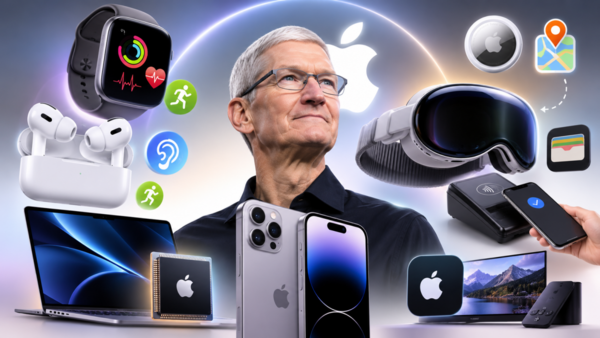
[DigitalToday reporter Jinju Hong] After Tim Cook became Apple chief executive officer, Apple did more than add new products. It significantly changed what existing devices do. The Apple Watch evolved into a health-management device and AirPods into a hearing-assistance device. The iPhone also took on payments, identity checks and even satellite communications. The hardware-based ecosystem also led to a services business generating more than $100 billion a year.
On Nov. 9 (local time), IT outlet Engadget reported that since Cook took office in 2011, Apple’s strategy has focused on boosting ecosystem use by adding new functions and roles to existing products rather than creating entirely new product lines.
Apple now runs its ecosystem on more than 2.5 billion active devices. Net sales in fiscal 2025 reached $416.2 billion. Its strategy of continuing to evolve familiar products and encouraging users to use multiple devices and services together became the foundation for expanding the business.
The most prominent change is the Apple Watch. When it first launched in 2015, it largely served as a companion device for checking iPhone notifications and recording activity. In 2018, the Apple Watch Series 4 added an ECG app and fall detection, expanding into health management.
Apple continued to add health-related features. watchOS 11 introduced sleep apnea notifications, the Vitals app and training load, and the Apple Watch Series 11, released in 2025, added a sleep score and high blood pressure alerts. It developed beyond simply checking workouts into a device that continuously monitors users’ health conditions.
AirPods also shifted from wireless earbuds for listening to music into devices with health and accessibility features. After strengthening ties to Apple’s ecosystem through automatic pairing, device switching, active noise cancellation and spatial audio, Apple added hearing management features.
AirPods Pro 2 introduced hearing tests, hearing-aid functions and hearing protection. The features target users with mild to moderate hearing loss. AirPods Pro 3 also added heart-rate detection, expanding uses during exercise.
On the Mac, the biggest change is the shift to Apple Silicon, its in-house processors. Apple announced in 2020 plans to move from Intel processors to its own chips, and that year applied the M1 chip to the MacBook Air, the 13-inch MacBook Pro and the Mac mini.
By integrating the CPU, GPU and Neural Engine into a single system-on-chip, Apple improved power efficiency and performance while bringing the technical foundation of the iPhone and iPad closer to the Mac. Apple also reinforced a structure in which it directly controls core technologies, from chip design to hardware and the operating system.
The iPhone expanded its role around camera, payments and communications. The iPhone 11 introduced an ultra-wide camera, Night mode and Deep Fusion, changing the photo-taking experience. The iPhone 12 Pro added Apple ProRAW, and the iPhone 15 Pro supported 48-megapixel main-camera shooting and ProRes video recording based on external storage devices. Smartphone cameras became one of the iPhone’s key competitive strengths.
The iPhone also took on the role of replacing a physical wallet. Apple Pay, introduced in 2014, turned smartphones into a payment method, and the Wallet app began to hold event tickets, transit cards, digital keys and IDs. Apple said Apple Pay expanded its use over 10 years to 78 regions, tens of millions of stores, and millions of websites and apps. Partner banks and network partners also surpassed 11,000.
Communications features also expanded. Apple introduced 5G on the iPhone 12 in 2020, and MagSafe broadened wireless charging and the accessories ecosystem. In 2022, the iPhone 14 added a feature allowing users to contact emergency rescue services via satellite when cellular or Wi-Fi is unavailable. Support later expanded to satellite-based location sharing and general messaging.
The expansion of the hardware ecosystem led to growth in services. Apple’s services segment posted revenue of $109.2 billion in 2025. The business includes the App Store, advertising, cloud, Apple Music, Apple TV and Apple Pay. In early 2026, quarterly revenue exceeded $30 billion for the first time.
The App Store also grew. Apple said that in 2025 the App Store’s average weekly users exceeded 850 million, and cumulative earnings paid to developers since the store’s 2008 launch topped $550 billion. It is a structure in which the user base secured through hardware feeds into revenue from apps, content and subscription services.
Content also became a new growth axis for Apple. Apple TV, launched in 2019, expanded from distributing other providers’ content into a platform producing its own originals. It introduced titles including "The Morning Show," "See" and "For All Mankind," and the film "CODA" in 2022 became the first streaming movie to win the Academy Award for Best Picture.
In 2025, Apple original productions received 81 Emmy nominations. "Severance" had 27 and "The Studio" had 23. Apple said that by September 2025, its original productions had won 620 awards in total and received 2,816 nominations.
Apple also continued to challenge new devices and platforms. Vision Pro, unveiled in 2023, is a mixed-reality device Apple calls a "spatial computer." Based on visionOS controlled by eyes, hands and voice, it places apps that were confined to screens into the user’s surrounding space. At launch, more than 600 apps and games were available specifically for Vision Pro, but its price of $3,499 remained a factor blocking mass adoption.
AirTag is an example of the network effects of Apple’s ecosystem. It uses the Find My network, where nearby Apple devices relay location information without a separate GPS or cellular connection. The second-generation AirTag, released in 2026, improved Bluetooth range and precision finding, and linked location sharing with airlines to help recover lost luggage.
Under Cook, the core of the changes Apple pursued was expanding how it uses products it already has, rather than continuing to add new ones. The watch evolved into a health-management device, earbuds into hearing-support devices, and the smartphone into a wallet and communications device. The broadened hardware ecosystem connected users to Apple services and became a foundation for generating ongoing revenue after device sales.
 Jinju Hong
hongjj@d-today.co.kr