
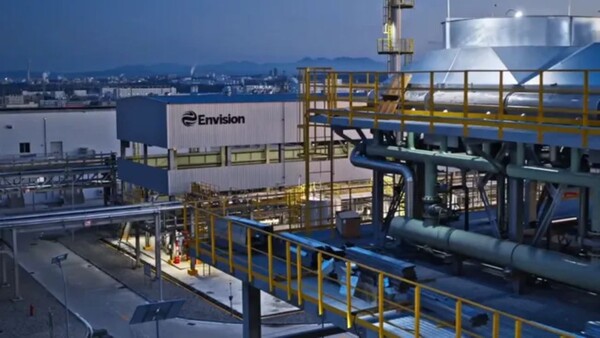
[DigitalToday intern reporter Yoo Seung-a] Chinese energy company Envision said it has commercially applied an integrated 800V direct current power system at an artificial intelligence data centre in Inner Mongolia.
On Nov. 9 (local time), IT outlet TechRadar reported that the system is supplying power for actual AI computing at the Galaxy AI Campus in Ulanqab. Envision claimed it is the first case in the world to commercially apply such a power structure at a large-scale AI data centre.
Envision tested the Dubhe controller and an energy model there from August 2026. It has not disclosed any independently verified figures to prove the system's performance so far.
The key is the power conversion structure. Existing data centres go through multiple conversion stages before supplying power to servers and AI accelerators. That process can increase related equipment and lead to power losses. Envision instead adopted an approach that uses a solid-state transformer to convert 10 kV medium-voltage alternating current into an 800V direct current distribution network.
The company explained that the structure reduces power conversion stages to improve efficiency and can also sharply reduce the space taken up by power equipment inside the data centre. It said higher distribution voltage can cut the amount of copper needed for cables, lowering material burdens for large computing facilities.
The system also integrates battery storage. It responds quickly when processor power demand changes abruptly and provides temporary backup power during unexpected outages. Envision said the battery supports power boosting over seconds and backup over minutes, and that the Dubhe controller controls the transformer and battery in milliseconds to respond to sharp changes in graphics processing unit power demand.
Power demand for AI computing can fluctuate widely depending on workloads, making stable power supply important. Envision said its system supports high-density server racks, allowing more computing equipment to be installed in the same space.
It also laid out an expansion plan. The Galaxy campus ultimately targets a capacity of 3 GW and was designed to support 1,000,000 AI accelerators when completed. Envision plans to apply the technology to its "Mission Gobi" project, which aims to build 5 GW of renewable energy-based AI data centre capacity in desert regions by 2030.
Still, it has not released independent measurement results to demonstrate the scale of efficiency gains, installation costs or savings compared with existing power systems. It has also not been confirmed whether the same performance can be delivered in situations where maximum loads last for long periods or at data centres with different hardware configurations. The buildout is significant as a commercialisation case for an 800V direct current power system, but additional verification is needed for operational advantages.
 Yoo Seung-a
ysah@d-today.co.kr