
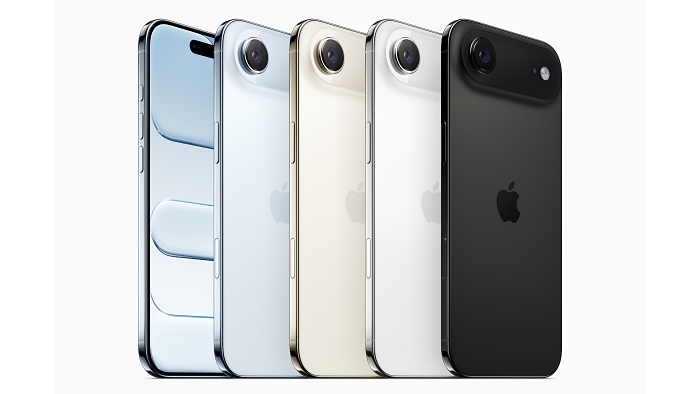
[DigitalToday reporter Jinju Hong] Apple is expected to unveil the second-generation iPhone Air next spring, and the new model is being prepared in a direction that adds a second camera as it reworks the existing design.
On Nov. 7 (local time), IT outlet NineToFiveMac said the key issue for the iPhone Air 2 is whether it can secure a clear position within the iPhone lineup beyond being a simple follow-up model.
The first-generation iPhone Air was seen as a technical achievement for delivering a near-flagship user experience despite its thin body, but it did not lead to mass sales due to a high price and several compromises. The outlet noted that the iPhone Air "was not a huge seller," but said it was an "engineering achievement" that packed a significant level of flagship experience into a thin design.
Apple is expected to first address two major weaknesses in the second generation. One is adopting a dual-camera setup, and the other is expanding battery capacity. That is seen as an adjustment aimed at reducing key constraints cited in the first generation. In particular, as the new product will find it harder to draw attention solely on the freshness of a first appearance, it needs to persuade a broader base of demand beyond existing enthusiasts.
The issue is that the tasks to be addressed do not end there. Speaker performance, connectivity and charging speed, and limits on camera functions also remain. The first-generation iPhone Air used a mono earpiece speaker and drew criticism that the audio experience was not sufficient. Apple introduced audio display technology that produces sound through display glass on the iPad mini 8, and attention is focused on whether the technology will be applied to the iPhone Air 2 as well.
Wired connectivity and charging specifications are also expected to be compared. The first-generation iPhone Air supported only USB 2, while the Pro models supported USB 3. NineToFiveMac said it "may not matter to most consumers" but argued that such specifications should be provided because the iPhone Air price is very close to the Pro models. There was also a gap in charging. The iPhone Air supported 20W MagSafe and 25W fast charging, while the iPhone 18 Pro supported 25W MagSafe and 60W fast charging.
For the camera as well, functional competitiveness is expected to become important beyond simply increasing the number of lenses. Limits on image quality could remain due to a small sensor, but the first generation had restrictions in areas such as RAW support, cinematic mode and macro mode. As macro mode is tied to the absence of an ultra-wide camera, adding a second camera raises the possibility of improvement.
Ultimately, the task for the iPhone Air 2 is to keep the thin design while shedding the perception that it is a symbol of compromise. The outlet said, "Being thin should be a feature, not a justification for compromises." It also said that "if the price gap with Pro iPhones is limited to around $100, the user experience should also be offered at a level close to that."
In this context, the iPhone Air 2 is likely to become a test bed for gauging Apple's product strategy. If the first generation had a character closer to a technology demonstration, the second generation needs to establish itself as a product that can broaden actual demand. As a second camera and a larger battery may not be enough, whether Apple improves speakers, charging, connectivity and camera functions overall is expected to be the key point to watch at next spring's unveiling.
 Jinju Hong
hongjj@d-today.co.kr