
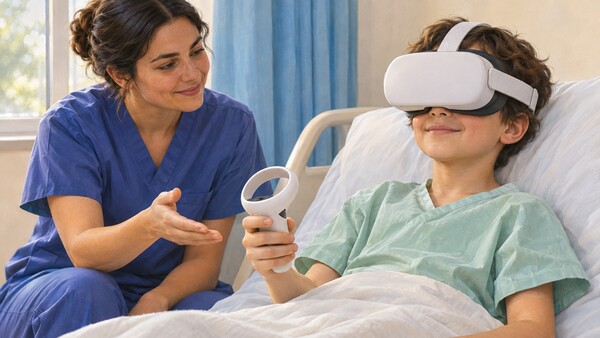
A study has found that children facing surgery who experienced VR content had lower anxiety and fear, as well as reduced heart rate and blood pressure. The findings are drawing attention to the potential use of VR as a non-drug way to ease pre-surgery tension.
According to Japanese media outlet Gigazine, a research team at Virginia Commonwealth University (VCU) analysed psychological and physiological changes before and after VR experiences in 80 children aged 6 to 15. The results were published in the international journal PLOS Digital Health.
The researchers created two virtual spaces to help children feel comfortable. The first was a child’s room with toys and a virtual TV, featuring objects that responded to gaze and controller input and calm background music.
The second was a beach scene combining gentle waves, palm trees and clouds. It was designed to reduce tension by recreating natural movement and ambient sounds. To prevent VR sickness, the viewpoint was fixed and teleportation was used for scene transitions.
The study was conducted over nine months at a children’s hospital in Richmond, Virginia. Participants used a Meta Quest 2 headset for an average of 9 minutes, and the researchers measured psychological discomfort, fear, heart rate and blood pressure before and after the session.
The median score for psychological discomfort fell to 1 from 3 out of 10. Fear also declined to 0 from 1 out of 4.
Average heart rate fell by 5.8 beats per minute to 80.5 from 86.3. Average systolic blood pressure dropped by 4.1 mmHg to 109.8 from 113.9 mmHg.
Satisfaction was also high. Some 91 percent of children said they wanted to use VR again, and 95 percent of guardians said they would recommend it to other children. All 29 participating nurses also gave a positive assessment of its use. Minor adverse reactions were reported in 3 of the 80 participants.
The study did not include a control group that did not use VR. It therefore cannot conclude that the reduction in pre-surgery anxiety was due to VR itself, and it did not prove VR could replace sedatives.
The researchers stressed that additional controlled experiments are needed to confirm VR’s actual effects and its potential for clinical use.
 Jae-won Choi
ittt_0801@d-today.co.kr