
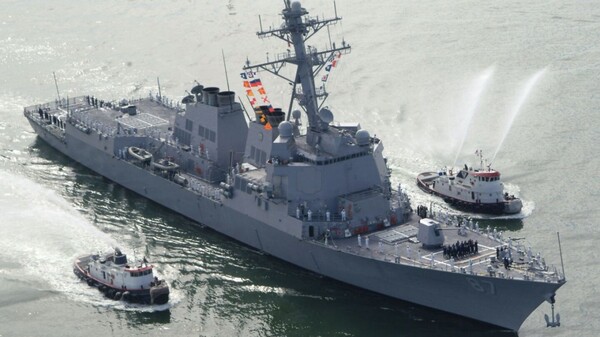
A programme pushed by U.S. President Donald Trump to build an ultra-large nuclear-powered battleship is facing pressure for review as power shifts in Congress, putting the U.S. Navy’s next-generation destroyer programme back in the spotlight. Some see the Navy prioritising a relatively more realistic next-generation destroyer instead of a battleship with a per-ship cost of up to $23 billion, or about 31 trillion won.
Military Watch Magazine, an international military and defence publication, reported on Nov. 5 that Democrats’ victory in the November 2026 midterm elections will give them control of both chambers of Congress from January next year. It said congressional review of the Trump administration’s new surface combatant programme is expected to become tougher. If the high-cost “Trump-class battleship” (BBG(X)) comes under review, analysis suggests the next-generation destroyer (DDG(X)), pushed down the priority list, could emerge as an alternative.
At the centre of the controversy is BBG(X), a core project of the “Golden Fleet” naval rebuild plan that Trump announced in December 2025. It is an ultra-large guided-missile battleship with a displacement of about 35,000 tonnes, 3 to 4 times the size of the Arleigh Burke-class, the U.S. Navy’s main destroyer. It aims to be a next-generation combat ship with nuclear propulsion and large-scale missile armament, but controversy has continued since early in the programme over massive construction costs and an unclear operating concept.
The biggest obstacle is cost. According to an estimate the U.S. Congressional Budget Office (CBO) presented in August 2026, the first BBG(X) ship could cost about $23 billion to build, and follow-on ships could average $18 billion, or about 24 trillion won. Mark Montgomery, a senior fellow at the Foundation for Defense of Democracies and a retired rear admiral, said, “With the cost of a single battleship, you can build up to 10 Arleigh Burke-class destroyers,” pointing to disadvantages in force generation relative to cost.
The controversy could create a new opportunity for the DDG(X) next-generation destroyer. DDG(X) is the U.S. Navy’s next-generation guided-missile destroyer programme intended to replace the Arleigh Burke-class, which has undergone performance upgrades for decades. Development was initially considered as a successor to the Arleigh Burke-class, but the emergence of BBG(X) raised the possibility that DDG(X) could be pushed down the priority list or effectively replaced.
The U.S. Navy’s push to develop a new destroyer stems from structural limits in existing ships. Flight III, the latest Arleigh Burke variant, significantly strengthens radar and combat systems, but it retains the existing hull design, leaving insufficient space for additional weapons and sensors. Critics also point to constraints in power supply and cooling capacity, limiting integration of future weapon systems.
DDG(X) is designed from the hull up to address these issues. At the concept stage, displacement is about 14,500 tonnes, larger than the roughly 9,700 tonnes of existing Arleigh Burke-class ships. A key goal is to inherit Flight III’s Aegis combat system while introducing an integrated electric propulsion system and securing space and power margins to add new sensors and weapons in the future.
Its armament is also being considered for expansion beyond current destroyers. The U.S. Navy presented a concept that would add 12 separate launch cells capable of operating large missiles, in addition to 96 cells of the Mk 41 vertical launching system. The aim is to keep existing missile operating capacity while also accommodating future large and long-range weapon systems.
DDG(X) also drew attention as a large surface combatant that could respond to China’s naval buildup. Expectations were raised that it could secure competitiveness versus China’s Type 055 destroyer in terms of firepower, hull size and stealth design. For now, it is at a stage of refining the design concept, and whether it will be built and deployed depends on future budgets and congressional review.
Another challenge facing the BBG(X) programme is the U.S. shipbuilding industrial base. Only 2 shipyards in the United States can build nuclear-powered ships, and reactor suppliers are also limited. With production capacity already tight due to aircraft carrier and nuclear submarine schedules, adding an ultra-large battleship could disrupt the securing of key capabilities, raising concerns. There is also the possibility that resource allocation could clash with the Columbia-class programme, the United States’ next-generation nuclear ballistic missile submarine project.
The midterm election outcome is expected to affect the U.S. Navy’s next-generation surface combatant force plan. If a Democrat-led Congress intensively verifies BBG(X) costs and project feasibility, DDG(X), which is relatively more closely linked to existing Navy force structures, could return to the top of the priority list.
Even if the BBG(X) programme is scaled back or cancelled, that does not mean DDG(X) will automatically move forward. Key questions include how Congress will allocate budgets across projects and how the U.S. Navy will adjust the size and armament configuration of next-generation surface combatants. Attention is focused on whether a destroyer centred on practical force enhancement will emerge as an alternative to an ultra-large battleship that requires massive spending.
 Jinju Hong
hongjj@d-today.co.kr