
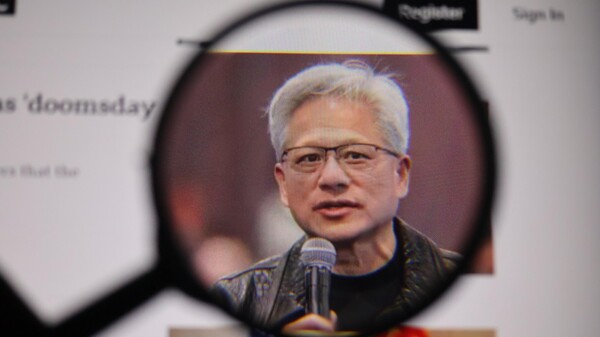
Nvidia's board has launched an independent investigation to determine whether Chief Executive Jensen Huang became a target of Chinese information operations. As controversy grows over Huang's relationship with a person suspected of ties to Chinese intelligence, the fallout is spreading beyond corporate risk to U.S. semiconductor export controls on China.
Business Insider reported on Nov. 9 that Huang shared a memo with employees that day saying he had been unfaithful to his wife. The issue, intertwined with suspicions of Chinese intelligence activity, led to Nvidia's independent board probe.
The controversy stems from the relationship between Nvidia and Alice Huang, who is suspected of being a Chinese intelligence asset. The New York Times reported in October that U.S. authorities suspected Alice Huang of being a Chinese intelligence asset and determined that she had a relationship with Jensen Huang while working as an executive at Megaspeed, a Nvidia customer.
The matter is spreading beyond a personal controversy to become a national security risk for Nvidia. Key questions include whether China sought access to advanced U.S. artificial intelligence semiconductor technology and supply chains, and whether related companies knew of it and responded appropriately.
Industry and market reactions were mixed. Pershing Square CEO Bill Ackman said empathy and support were needed for Huang. In a post on X, formerly Twitter, he wrote that Huang is human and can make mistakes, and that he should be supported with his family as he takes responsibility for his actions.
Others called for accountability over U.S. export controls. Chris McGuire, a senior fellow at the Council on Foreign Relations, said Commerce Department leadership opposed tightening export controls on Nvidia's advanced chips despite knowing relevant circumstances.
McGuire said that if Megaspeed was used as a channel to evade China's semiconductor export controls, the Commerce Department could have immediately blocked shipments but did not. He also said existing rules requiring separate export licences to supply large volumes of AI semiconductors to hard-to-trust counterparties were not properly enforced. McGuire urged strengthening Nvidia's national security response while the U.S. government strictly applies export controls on China.
In Silicon Valley, some reactions linked the episode to U.S.-China competition for AI dominance. Angel investor and "All-In" podcast host Jason Calacanis said the United States must win the global competition for AI leadership and protect Huang and Nvidia's technology. He said the United States should respond more quickly against China as Nvidia's technology has become a significant target.
Others said the controversy could hurt Nvidia's corporate reputation and political standing. Dan Ives, a partner and managing director at Yorkville Ives, said the matter would be a reputational burden for Huang and could trigger multiple congressional investigations.
In the U.S. Congress, some called for a hardline response. Republican Representative Michael McCaul of Texas said shipments of advanced AI chips to China should be halted immediately until the truth of the allegations is confirmed. He strongly criticised the case, linking it to what he called typical Chinese Communist Party intelligence-gathering methods.
As concerns around Nvidia grow, some continued to defend Huang's role. Sequoia Capital partner Shaun Maguire called Huang one of the greatest entrepreneurs of the era but said the matter could lead to harmful outcomes for the United States. He said he did not believe Huang had malicious intent and stressed it would be difficult to replace him in maintaining U.S. leadership in AI technology.
Ross Gerber of Gerber Kawasaki Asset Management also expressed disappointment at the news. He described it as an error in judgment at a time when the AI industry faces an important turning point.
The fallout is not expected to stop with the results of Nvidia's board investigation. That is because it could lead to follow-up probes by the U.S. Congress and discussions on restricting exports of advanced AI semiconductors to China. With Nvidia, a leader in the global AI semiconductor market, caught in a national security controversy, tensions are also rising over U.S. technology strategy and corporate business with China.
 Jinju Hong
hongjj@d-today.co.kr