
South Korea's Personal Information Protection Commission urged users of smart glasses to disclose when they are filming or recording and to refrain from wearing them in places where filming is prohibited. The commission will draw up guidelines this year featuring proper use cases.
The commission said on Nov. 9 it had issued guidance on major privacy infringement risks and usage precautions as concerns about smart glasses have grown, including cheating and invasion of privacy.
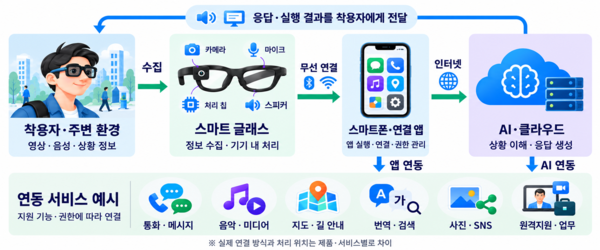
Smart glasses are equipped with cameras, microphones and sensors and linked with AI to collect and process video and audio information. They resemble ordinary eyeglasses or sunglasses in appearance and can take photos or videos without separate filming gestures.
Even if they have a light-emitting diode (LED) indicator that signals filming, people nearby may find it hard to notice, or users may be able to cover the indicator. Some products can film even when not being worn, raising privacy concerns.
The commission recommended that smart glasses users check, at the initial setup stage, the purposes for collecting and using personal information by the device and linked apps and services, and disable unnecessary functions. It said users should refrain from using smart glasses, or avoid wearing them if possible, in places where filming is prohibited such as toilets and changing rooms, as well as in places where filming is restricted such as courts and exam venues.
In situations where people nearby may be filmed at close range or conversations may be recorded, users should, as much as possible, give prior notice that filming or recording is taking place. If the other party refuses filming or recording, it must be stopped.
Unauthorised filming may constitute an infringement of portrait rights. Depending on the content and method of filming, it may fall under laws including the Act on Special Cases Concerning the Punishment of Sexual Crimes, the Information and Communications Network Act and the Protection of Communications Secrets Act. If used for cheating at an exam venue, users may also face sanctions under relevant exam laws and regulations.
The commission stressed that information collected through smart glasses can be processed through various channels, including smartphones, AI, cloud services and third-party services. It said the risk of privacy infringement could grow if video or audio of people nearby, rather than the user, is used for AI training or on social network services (SNS).
It told service providers to clearly explain the purposes of collecting and using personal information and the processing process, and required them to meet legal requirements for processing, such as prior consent, if personal information is used for AI training. It also urged manufacturers to design products so that people nearby can easily recognise whether filming or recording is taking place.
The commission plans to draw up a "Smart Glasses Personal Information Protection Guideline" this year setting out specific items that users, manufacturers and service providers should comply with.
Song Kyung-hee (송경희), chairperson of the commission, said smart glasses are entering people's daily lives and the risk of personal information and privacy infringements is emerging as a reality. She said the commission would continue to improve systems so personal information can be protected safely without hindering innovation.
 Jin-ho Lee
jhlee26@d-today.co.kr