
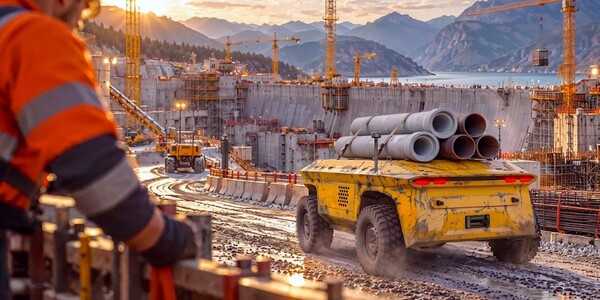
Renault Group is seeking to enter the military unmanned ground vehicle market. Building on its electric vehicle expertise, it has worked with a defence company to develop an electric ground vehicle platform with autonomous driving functions.
Electrek, an electric vehicle media outlet, reported on Nov. 8 local time that Renault Group unveiled the Forefront unmanned ground vehicle concept co-developed with Belgian electronics and defence company John Cockerill.
Forefront is a modular ground vehicle platform designed with demanding missions for the French Army in mind. It is designed to enable rapid industrialisation and cost-efficient production, and developed to deliver mobility and driving performance in rugged terrain. It also has the ability to move autonomously through complex terrain. It is currently at a concept stage, developing remote-control and autonomous-driving functions, and is not a mass-produced vehicle with full autonomous driving.
The companies presented Forefront as a platform that can be used broadly in military and civilian fields. In the military, it can be used for tasks such as frontline logistics support. In the civilian sector, the idea is to deploy it for remote work in high-risk areas or hard-to-access environments.
Francois Provost (프랑수아 프로보), Renault Group's chief executive officer, said Forefront applies the group's industrial and technological capabilities to the unmanned ground vehicle market for civilian and military use. He also stressed that the project combines Renault Group's ability to rapidly develop and produce high-performance technology products at scale and cost-efficiently with John Cockerill's defence expertise.
The two companies split development based on their respective expertise. Renault Group provided vehicle platform design and mass production capabilities, while John Cockerill added technology and experience in the defence sector. Their goal is to deliver a modular unmanned ground vehicle that can be developed and produced quickly.
Forefront remains at the concept stage. Renault Group plans to deploy the vehicle in multiple training sessions and field tests in the coming weeks to validate and refine the concept in real operating environments. It plans to reflect user feedback gathered during testing to specify potential uses in military and civilian fields.
 Yu Seung-a
ysah@d-today.co.kr