
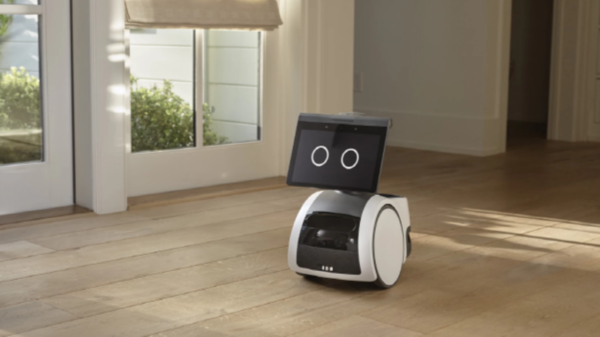
[DigitalToday intern reporter Yoo Seung-a] Amazon is trying again in the consumer robotics market despite the limited performance of its home robot Astro. It is expanding its home robotics business by forming a new development team and acquiring a robotics startup.
CNBC reported on Nov. 8 that Amazon has formed an organisation in recent months to develop an entirely new robot product.
Astro began as an idea of Jeff Bezos (제프 베이조스), Amazon's founder and chief executive at the time. Unveiled in 2021, the wheeled robot includes the Alexa artificial intelligence assistant. It was designed to autonomously navigate the home, recognise faces and serve as a security monitor. It did not move beyond an invitation-only sales model, and actual shipments were limited to a few thousand units. A business-use product launched in 2023 was also discontinued in less than a year.
Amazon moved to new development instead of dropping the business. Job postings say the company is developing a robot that operates autonomously in a living environment shared with families and can move through a home that changes frequently. In March, it acquired New York-based robotics startup Vona Robotics and established a Personal Robotics Group. Vona developed Sprout, a 3.5-foot-tall humanoid robot. Amazon is also hiring field support engineers and user experience designers, mapping out customer support, on-site repairs and the experience of living with robots.
Andy Jassy (앤디 재시), Amazon's CEO, recently called AI and robotics one of the "biggest inflection points" of our lifetime in an annual letter. Amazon says it is investing in the consumer robotics market with a long-term perspective.
Astro's usefulness has been limited. Emily Lugo Velez said that since using the product in 2023, Astro has effectively been a party device and a tripping hazard, aside from checking on pets and the status of appliances while away from home. Some users are raising concerns about possible discontinuation, citing reduced customer support and a lack of support for Alexa+. Amazon said it will continue support for Astro users.
The market environment has changed since the first product launch. Ken Washington (켄 워싱턴), a former vice president at Amazon for consumer robotics, said there were discussions at the time about adding an arm that could pick up and examine objects to expand Astro's capabilities. Colin Angle (콜린 앵글), iRobot's co-founder and former CEO, said advances in AI models, sensors, batteries and actuators have significantly changed the development environment for robots.
Investment in the robotics market is also rising. Barclays projected in a report in January that the global humanoid market, currently worth $2 billion to $3 billion, will grow to about $40 billion by 2035 and could reach $200 billion under an optimistic scenario. PitchBook said venture investment inflows into robotics and physical AI companies in the first half of this year totalled $33.4 billion, exceeding the full-year total of $28.7 billion in 2025.
Amazon operates more than 1 million robots in logistics warehouses, but homes are different. Conditions vary from household to household, including children, pets, older people and stairs, making it difficult for robots to operate reliably. Detailed functions and the release timeline for the new robot have not been disclosed. Attention is on whether Amazon can overcome the limits of home robots based on its experience developing Astro and technological advances.
 Yoo Seung-a
ysah@d-today.co.kr