
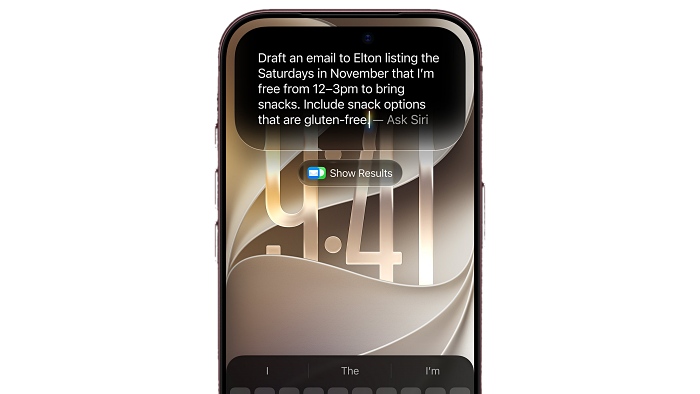
Apple may as early as next year develop its voice assistant Siri into an agent-style artificial intelligence that proactively carries out tasks on a user’s behalf, a report said. After unveiling a Siri with stronger personalisation features in iOS 27, Apple is seen reviewing the next step: functions that track goals and continue necessary tasks without users having to give step-by-step instructions.
On Nov. 8, IT outlet 9to5Mac reported that Bloomberg’s Mark Gurman (마크 거먼) wrote in the Power On newsletter that Apple could develop Siri into a form closer to an agent as early as next year.
Siri has enhanced personalisation features and conversational ability, but it still lacks the ability to track goals and continue necessary tasks without users making requests each time. Meta and xAI, among others, are focusing on developing agent-style AI that handles tasks in the background without waiting for user instructions and then delivers the results. OpenAI’s Dots, Meta’s Muse and xAI’s Grok are cited as such examples.
Gurman explained that these agents understand a user’s goal and decide what tasks are needed next, continuing toward the goal without receiving separate instructions at each step. He added that Apple ultimately aims in the same direction and, given market and consumer demand, has no choice but to develop Siri into something closer to an agent. He said it remains unclear what specific features Apple will introduce.
Apple’s competitiveness is cited as its existing software base. The explanation is that because it has already built frameworks such as App Intents, it can handle some tasks without relying heavily on computer-use capabilities like other companies. This could also make it possible to lower the cost of executing certain tasks.
Apple is also changing internal engineering processes ahead of developing iOS 28. Gurman said Apple adjusted its development schedule so engineers spend more time coding and exploring features than integrating operating system functions.
Apple typically allocated 4 weeks each to the coding and exploration stage and to the feature integration stage. In the first development cycle for iOS 28, it assigned 6 weeks to coding and exploration and 2 weeks to integration. The step is aimed at giving engineers more time to flesh out ideas and test features. The rapid development of agent-style coding tools in recent years may also have influenced the change, the report said.
 Seungah Yoo
ysah@d-today.co.kr