
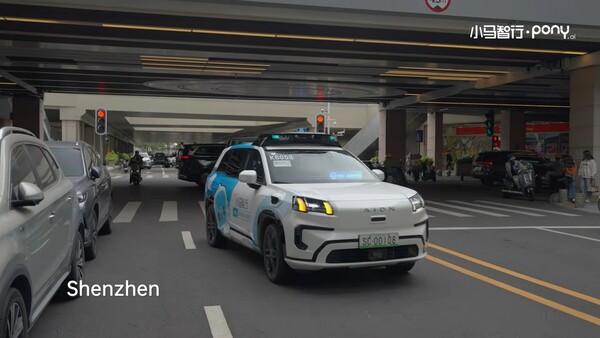
China's robotaxis are spreading beyond pilot programmes into an everyday means of transport. Their strengths include a pleasant driverless cabin and stable driving. But call wait times and limited pickup and drop-off points are still seen as areas to improve.
On Nov. 7, local time, the South China Morning Post compared two services by using Pony.ai in Shenzhen and Baidu's Apollo Go in Beijing.
A Pony.ai vehicle summoned in Shenzhen was shown in the app as arriving in 5 minutes, but the actual wait was about 10 minutes. After it arrived, the rider scanned a QR code to board, and the ride began only after the seat belt was fastened. An in-car screen displayed nearby vehicles, pedestrians and bicycles in real time.
Driving style differed. Pony.ai yielded early to electric scooters and pedestrians and braked with leeway, operating cautiously. Apollo Go accelerated and changed lanes more assertively, but braked more often.
Both shared the advantage of a quiet private space with no need to talk to a driver. Riders could control air conditioning and music themselves. On Apollo Go, voice commands and a rear-seat massage function were also available.
Pickup and drop-off convenience had limits. Both services required use of set operating zones and designated pickup and drop-off points, meaning riders had to walk several hundred metres before and after trips. Pony.ai explained that remote staff provide support when roads are controlled or severe congestion occurs, but the vehicle system makes the actual driving decisions.
The business is expanding quickly. Pony.ai's second-quarter robotaxi service revenue rose 691.2 percent from a year earlier to $12.1 million. As of the end of June, it had 1,975 vehicles in operation, and by mid-August registered users in China had topped 1.5 million.
Service areas have also expanded to major cities including Beijing, Shanghai, Guangzhou and Shenzhen. Still, an assessment says expanding pickup and drop-off points and improving dispatch efficiency are needed to achieve accessibility that could replace regular taxis.
 Jae-won Choi
ittt_0801@d-today.co.kr