
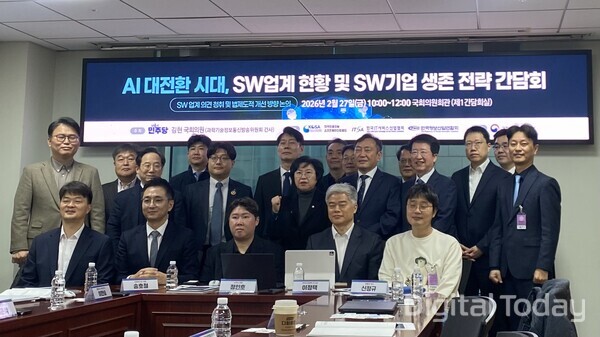
[DigitalToday reporter Seulgi Son] "Even in an era of a sweeping AI shift, the software industry market itself remains intact. But policy responses are urgently needed to address developer workforce cuts and to build a policy foundation for the survival of small and medium-sized software companies."
At a meeting titled 'In the era of a sweeping AI shift, the state of the software industry and the survival of software companies' held on Feb. 27, domestic software industry officials made clear that forecasts that AI will threaten the software industry are an overreaction. The event was hosted by Democratic Party lawmaker Kim Hyun and organised by the Korea AI & Software Industry Association (KOSA).
Participants from industry and academia, including Douzone Bizon CEO Song Ho-cheol (송호철) and ITCEN ENTECH Vice President Lee Jung-taek (이정택), discussed the state of the software industry during the AI transition and directions for legal and institutional improvements.
As the first presenter, Song drew a line under concerns that AI will replace existing software. He said there are clear areas in the enterprise software market, such as enterprise resource planning (ERP) and accounting and HR systems, that AI cannot replace.
Song said, "To design and implement all the highly complex linkages, you need not just AI, but the ability that requires experience to give instructions and build very complex projects, and knowledge of that domain, so there are still limits."
Douzone Bizon said it achieved record-high revenue and operating profit simultaneously by adding an AI agent interface on top of its existing ERP. It said the structure is not one in which existing software-as-a-service (SaaS) is replaced, but one in which services become more efficient and more active by adding a new interface.
Song also laid out a growth direction. He forecast that modular software that can be combined with AI agent-based interfaces will draw attention. "Highly modular, specialised software in small areas will collaborate with each other through agent-based interfaces," he said. "Rather than making a big piece of software at once, many modular services that provide small functions will be created, and we will move toward implementing them in a way that interoperates among agents' interfaces."
The impact of AI on the public-sector system integration (SI) market is also likely to be relatively limited, he said. He cited the fact that most public projects are carried out in closed-network environments such as state networks, making it difficult to apply the latest AI tools. Lee said, "Because of security, things like cloud and many other options are coming out, but there are limits to applying them." He said each SI company is moving toward adopting AI platforms, but it is still at an early stage.
Bae Hyun-seop (배현섭), CEO of Soosung Softtech, expressed a similar view. Soosung Softtech supplies mission-critical software used in aircraft, nuclear power and autonomous driving to companies including Hyundai Motor and Hanwha Aerospace, and its operating profit rose 60 percent last year from a year earlier. He said the increase came because AI boosted productivity. "Software made by AI also has to be thoroughly verified to be used in aircraft or autonomous driving," he said, stressing that safety and reliability verification will remain a human domain that AI cannot replace.
Even so, a shared view in the industry is that workforce cuts will be inevitable.
Shin Jung-kyu (신정규), CEO of Rableup, said, "The software industry will not collapse. It will grow much bigger, but the number of people in it will drop dramatically." He added, "What we need is an AI driver, not a developer, and it could shrink to fewer than 100 people."
Bae said his company had hired more than 50 people a year, but cut that to 30 last year. "Honestly, it feels like we might not need to hire," he said. Cho Gi-hyun (조기현), CEO of Unfine, said, "We have barely hired any entry-level employees over the past two years," and pointed out that there is no place for junior staff to stand.
Kim Hyun, the Democratic Party's floor spokesperson on the National Assembly Science, ICT, Broadcasting and Communications Committee, also agreed on the seriousness of the staffing issue. "This is why people do not come to engineering schools," he said, pointing out that job anxiety in the AI era is leading to avoidance of science and engineering fields. He added, "For this discussion, the Education Ministry needs to come too, along with the Ministry of SMEs and Startups, the Public Procurement Service, the Industry Ministry and the Interior Ministry," stressing that there are limits to the Ministry of Science and ICT responding alone.
At the meeting, participants also called for strengthening the foundation so that small and medium-sized software companies can directly experiment with AI.
Park Chang-hoon (박창훈), an executive director at Innogrid, said, "We hear talk about a sovereign model and a national AI computing centre, but I do not know about a playground that SMEs can use." He added, "I got a quote to buy GPUs, but the validity period was one week, and some companies give quotes at the going market price at the time of supply." Novus CEO Jung In-ho (정인호) warned, "If AI looks too powerful, small companies will close their wallets and say, 'We can just use it when AI matures,' and then the rest of the market could truly be eliminated."
 Seulgi Son
sageson@d-today.co.kr
Seulgi Son
sageson@d-today.co.kr