
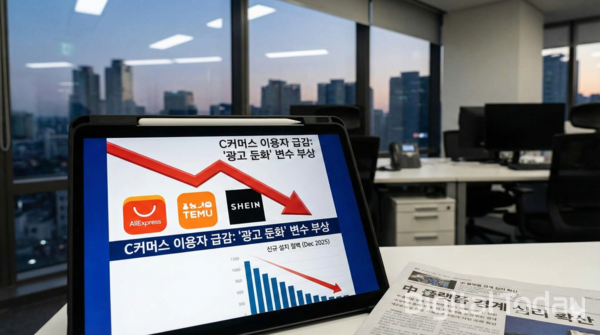
The growth of C-commerce platforms such as AliExpress, Temu and Shein, which had swept through South Korea's e-commerce market, has slowed. User numbers and payment volumes fell together. Analysts say it is a result of cuts in digital advertising spending.
According to weekly active user (WAU) figures compiled by app analytics service MobileIndex for the period from the fourth week of November 2025 to the fourth week of December 2025, indicators for the three C-commerce firms all declined.
Ali's WAU in the fourth week of December was 3.68 million, down about 17.4 percent from 4.46 million in the fourth week of November. Temu also fell 5.4 percent over the same period to 3.60 million from 3.81 million. Fashion platform Shein dropped 32.6 percent to 620,000 from 920,000.
Payment indicators, a proxy for revenue, also worsened. Wiseapp·Retail·Goods, which surveyed payment behavior among Koreans aged 20 and older, estimated Ali's payment volume in the fourth week of December at 17.7 billion won, down 32.5 percent from 28.3 billion won a month earlier. Temu also fell 22.2 percent, shrinking in both size and substance.
The industry points to reduced performance marketing spending as the main reason for the decline. C-commerce platforms have spent heavily on major social media such as Meta and YouTube to drive new installs, but analysts say they cut budgets as marketing efficiency weakened.
According to global market data firm Sensor Tower, Temu cut digital advertising spending by 52 percent to about $1.44 billion in 2025 from about $3.0 billion in 2024. Ali and Shein also reduced advertising spending by 34 percent and 25 percent, respectively, from a year earlier.
New inflows fell sharply after the ad cuts. MobileIndex said new installs for Temu and Ali, which reached 2.22 million and 1.21 million, respectively, in March 2025, fell in December to 730,000 and 300,000, down 67 percent and 75 percent. Shein hit a peak of 820,000 in July last year but fell 82 percent to 140,000 in December.
An industry official familiar with internal conditions at C-commerce platforms said, "They are companies that grew through digital ads, so brand loyalty is weak." The official added, "They began to weigh returns on investment for ad spending due to factors such as the Trump administration's regulation of small-value tariffs, and that trend appears to have carried over into South Korea."
AliExpress said, "There is no change related to our strategy for the domestic market, and we intend to provide diverse services as before."
Some analysts also say consumer distrust, in addition to ad spending, may have affected the downturn. According to a Seoul city survey conducted last November of 1,000 Seoul residents who had used China-linked e-commerce within the past six months, 52.4 percent of respondents said they felt anxious about "personal information leaks and security."
In the same survey, satisfaction with C-commerce customer service (CS) was also limited to 54 points, showing a gap with the average for domestic e-commerce platforms of 78 points. Eunhee Lee, an emeritus professor of consumer science at Inha University, said, "The personal data leak issue likely had a bigger impact on C-commerce than on Coupang." Lee added, "There is considerable fear among consumers that Chinese companies indiscriminately collect information, and as related information is shared quickly, people are judging the platforms more critically."
 Seulgi Son
sageson@d-today.co.kr
Seulgi Son
sageson@d-today.co.kr