
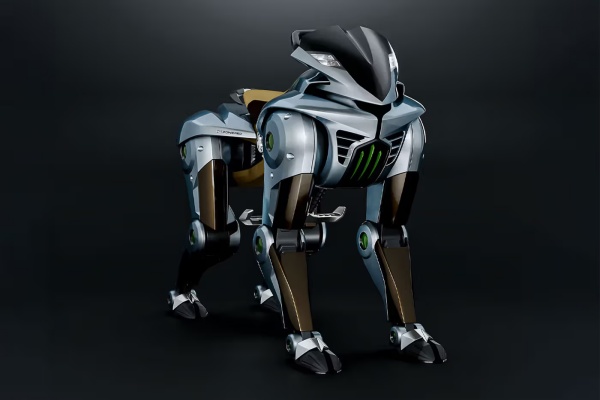
[DigitalToday reporter Jinju Hong (홍진주)] The personal mobility market has entered a new phase. Japan's major heavy-industry company Kawasaki Heavy Industries has moved to commercialise a personal mobility device in the form of a four-legged walking robot that differentiates itself from electric bicycles.
Electric-vehicle outlet Electrek reported on Feb. 26 that Kawasaki said it had begun official development aimed at commercialising its four-legged walking robot, CORLEO.
CORLEO was first unveiled last year at the Osaka-Kansai Expo 2025. A somewhat experimental computer-generated imagery (CGI) video released at the time became a talking point after recording 1.2 billion exposures on social media. Kawasaki went further by setting up a SAFE ADVENTURE business development team reporting directly to the president, elevating the project into a full-fledged business stage. In the long term, it is also reviewing plans to use it as an on-site mobility solution at Riyadh Expo 2030.
CORLEO is a combination of a "robot horse" and an electric adventure machine. It moves using articulated robotic legs instead of wheels, targeting environments that are hard for conventional wheeled vehicles to access, such as mountainous terrain or waterside areas. The rear legs use a swingarm mechanism derived from motorcycle suspension, enabling independent vertical movement and effectively absorbing shocks. Riders control direction and balance by shifting their weight, as in horseback riding, while an electronic assist system maintains stability in rough terrain.
Its power system is also unusual. Instead of a typical battery pack, it adopts a structure that uses hydrogen to generate electricity. If electric motorcycles or eMTBs are "wheel-based electrification", CORLEO effectively presents a new category of "walking-based electrification".
Kawasaki is expanding its software ecosystem alongside hardware development. It is building a riding simulator based on CORLEO motion data and plans to introduce a digital model for games and e-sports as early as 2027. It is targeting 2030 for a global debut of a functional prototype.
Some in the industry are sceptical. Still, Kawasaki's structural strength in running both a robotics business and a motorcycle business is seen as one of the few conditions that could bring such an attempt into the realm of reality. With competition to develop humanoid robots intensifying, Kawasaki is differentiated in that it chose a completely different mobility experience rather than making it resemble a human.
Electrek said, "It is still unknown whether we will be riding robot horses instead of electric bicycles in 2030. But what is clear is that Kawasaki does not seem to intend to leave this idea as a simple concept."
 Jinju Hong
hongjj@d-today.co.kr
Jinju Hong
hongjj@d-today.co.kr