
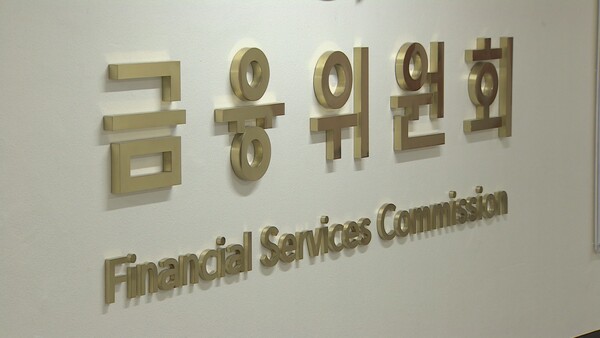
A decision on a preliminary licence for an over-the-counter exchange dedicated to fractional investment that will handle the distribution of tokenised securities (STO) has been delayed. Private startup Lucentblock publicly raised concerns about fairness in the licensing process and even filed a report with the Fair Trade Commission, a move seen as prompting financial authorities to take a cautious stance.
The Financial Services Commission on Tuesday did not place the preliminary licence agenda for a fractional-investment over-the-counter exchange on the docket of its regular meeting. The commission was previously reported to have held a Securities and Futures Commission meeting on Jan. 7 and selected two consortia as preliminary licence candidates: a Korea Exchange-Koscom consortium (KDX) and a Nexttrade-Musicow consortium (NXT).
It is extremely unusual for an item that was reviewed by an independent external evaluation committee and completed Securities and Futures Commission deliberations related to licensing for financial investment business to fail even to be tabled at a Financial Services Commission meeting.
The Financial Services Commission has said it would select up to two operators, and if that stands, Lucentblock, which has run a real estate fractional investment platform under a regulatory sandbox since 2018, would be excluded.
Heo Se-young, chief executive of Lucentblock, held an emergency news conference on Jan. 12 and raised concerns about fairness in the licensing process. On the same day, he submitted a complaint to the Fair Trade Commission, citing alleged obstruction of business activities and alleged violations of merger filing obligations.
He said Nexttrade signed a non-disclosure agreement on the pretext of reviewing an investment, received financial information, a shareholder register and core technology materials, and then filed a solo application for an STO licence in less than a month.
He said, "If we do not receive the licence this time, we will have no choice but to shut down because our regulatory sandbox status will expire," and added, "I have run the business for seven years trusting the government, but it feels like we were used as an experiment and then thrown away."
Lucentblock has operated a real estate fractional investment platform after being designated an innovative financial service by the Financial Services Commission in 2018. It has distributed assets worth a cumulative 30 billion won for 500,000 users, and is effectively the only startup that has maintained a fractional investment business to date among 758 companies participating in the regulatory sandbox.
Kwon Chil-seung, a Democratic Party lawmaker and former minister of SMEs and Startups, criticised the process, saying, "If a startup that has led a new market while taking risks is excluded during the institutionalisation process, it could shake trust in innovation policy at its roots."
The Korea Startup Forum also said, "Instead, it is leading to a result in which a company that attempted innovation first is being placed at risk of being pushed out of the market."
The Financial Services Commission, meanwhile, drew a line, saying, "Nothing has been confirmed," and "There is no procedural or legal problem."
Nexttrade countered, saying, "There was no theft of confidential materials or technology," and "This happened in the course of pursuing business, and there was no legal or moral problem." The Korea Exchange said it was "not an entrenched interest, but participating in a consortium to support the fractional investment industry."
Some in the industry also voice the view that the Financial Services Commission, in line with screening criteria presented in September last year, placed emphasis on distribution capabilities. The commission at the time listed consortium composition, participation by SME-focused brokerages and capacity to launch services quickly as bonus criteria.
Musicow, which is part of the Nexttrade consortium, said it was concerned that "if this controversy leads to delays in opening the market, the entire fractional investment industry could face a risk of collapse."
The preliminary licence is the first step in bringing fractional-investment distribution into the regulated system and is expected to have a major impact on the competitive structure of the STO market. An operator that receives a preliminary licence can apply for a full licence after securing staff and computer systems and can start operations within six months.
An industry official said, "In the industry, it was seen as practically difficult for Lucentblock to participate in the market," and added, "From the perspective of financial authorities, it is not easy to entrust a huge capital market to a startup that is not yet large in scale."
The official added, "With four fractional-investment startups such as Musicow, Sejong DX, Stockeeper and Together Art already included in consortia, it will not be easy to secure justification."
 Sangyeop Oh
yub@d-today.co.kr
Sangyeop Oh
yub@d-today.co.kr