
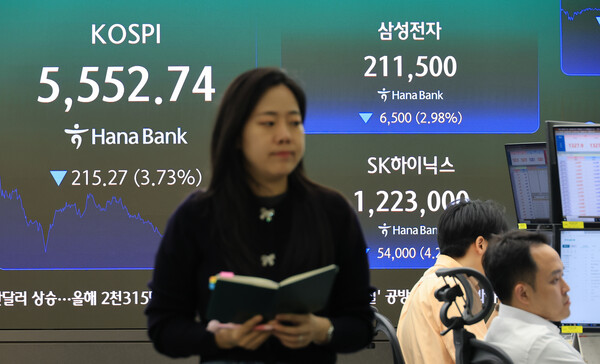
South Korea's stock market has repeatedly plunged, and the Korea Value-up Index, which represents the government's corporate value-up policy, has slid nearly 40 percent from its peak.
According to the Korea Exchange on Monday, the Korea Value-up Index closed at 2,631.25, down 100.19 points, or 3.67 percent, from the previous session. That is about 38.5 percent below its 52-week high of 4,276.72.
The Korea Value-up Index is made up mainly of companies active in raising corporate value and returning profits to shareholders. Major components include Samsung Electronics, SK Hynix, SK Square, Hyundai Motor, KB Financial Group, Kia, Shinhan Financial Group, Hanwha Aerospace and HD Hyundai Heavy Industries, as well as Hana Financial Group.
As the recent stock plunge drove down key index components in tandem, the value-up index also underwent a sharp correction. On the day, Samsung Electronics fell 2.98 percent and SK Hynix dropped 4.23 percent. SK Square slid 5.00 percent, Hyundai Motor 4.91 percent, Hanwha Aerospace 11.71 percent and HD Hyundai Heavy Industries 7.96 percent.
Exchange-traded funds (ETFs) tracking the Korea Value-up Index also could not avoid weak performance.
According to Koscom's ETF Check, RISE Korea Value-up fell 19.10 percent over the past month, KODEX Korea Value-up dropped 19.07 percent and TIGER Korea Value-up declined 18.92 percent. SOL Korea Value-up TR and TIME Korea Value-up Active also fell 19.27 percent and 19.71 percent, respectively, over the same period.
Most one-week returns have also been negative in the 7 to 9 percent range. It is not simply a problem with some stocks, but a broad deterioration in market sentiment that is pressuring value-up-related stocks and products at the same time.
The problem is that the longer the market correction lasts, the harder it becomes to evaluate the results of the value-up policy based solely on share price gains. When stocks were rising, the value-up policy and expectations for higher corporate value were highlighted at the same time. In a situation like the current market-wide plunge, it is becoming important whether companies can keep up shareholder returns such as larger dividends and treasury-share cancellations.
Concerns about duplicate listings are also resurfacing. With SK Hynix's U.S. subsidiary Solidigm preparing for a U.S. stock market listing, worries have been raised that it could damage the value of existing SK Hynix shareholders.
Lee Chan-jin (이찬진), chief of the Financial Supervisory Service, said at a parliamentary audit by the National Assembly's Political Affairs Committee on Sunday that regarding Solidigm's listing, "both the Financial Services Commission and the Financial Supervisory Service are judging that it conflicts with duplicate listing."
He added that they are waiting for an authoritative interpretation by the Financial Services Commission on whether the listing of an overseas subsidiary is directly subject to domestic rules on duplicate listings.
Financial authorities are strengthening shareholder protection measures under a principle of "banning duplicate listings in principle and allowing exceptions." But because subsidiaries listed on overseas markets, like Solidigm, do not undergo domestic exchange listing reviews, how far domestic shareholder protection rules can be applied has emerged as a new issue.
There is criticism that for the value-up policy to go beyond a simple index rise and become a long-term corporate value improvement policy, companies must maintain shareholder return policies even during market declines, and institutional responses must follow on issues such as duplicate listings that could undermine the value of existing shareholders.
With market volatility expanding sharply, whether the Korea Value-up Index rebounds in the near term, as well as major companies' dividend and treasury-share policies and whether rules on duplicate listings are specified, are expected to act as variables in judging the effectiveness of the value-up policy.
Noh Dong-gil (노동길), a researcher at Shinhan Investment, said, "The nearest inflection point is the specification of shareholder returns at the end of October." He said returns fill buying gaps and determine the durability of restored trust in earnings. He added that buybacks that are actually executed could affect short-term price stability.
Noh said, "Both Samsung Electronics and SK Hynix still have room for treasury-share buybacks." He said if additional purchases continue, repeated buy orders could flow in and help stabilise supply and demand during foreign selling.
 Oh Sang-yup
yub@d-today.co.kr