
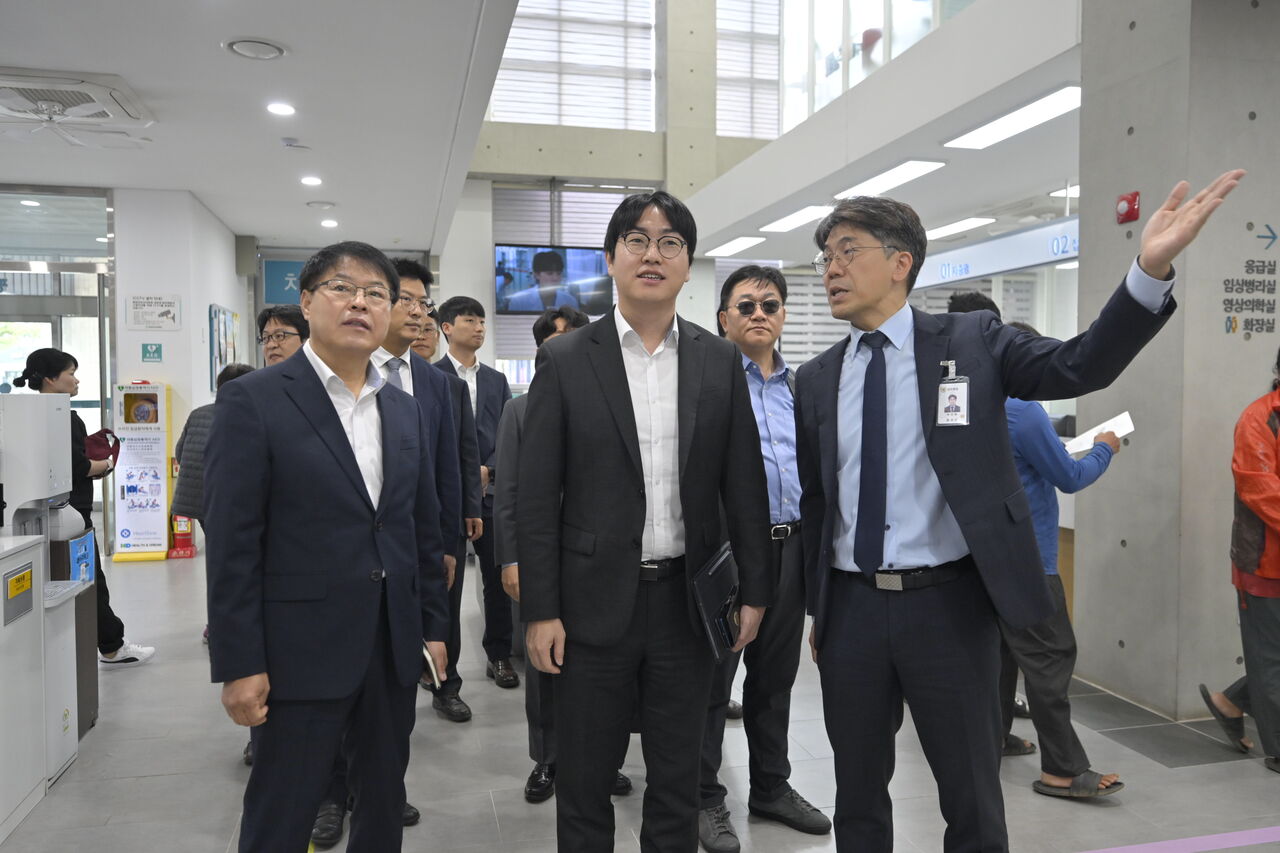
South Korea's presidential National AI Strategy Committee said on Monday that Standing Vice Chair Ha Jung-woo (하정우) visited Pyeongchang, Gangneung and Donghae in Gangwon Province for two days from Oct. 19 to inspect the status of AI policy implementation.
The trip was arranged to review progress on the Donghae AI data centre project included in the government's "three mega-projects for South Korea's great leap forward" and to check on-site cases of major policies such as AI-based basic healthcare, transport and talent development.
On Monday, Ha visited GS Donghae Power in Donghae, received briefings on the data centre construction plan and power and water supply measures, and looked around the planned site in the Bukpyeong No. 2 General Industrial Complex.
The Donghae AI data centre is planned to be built with a total capacity of 2.4 gigawatts by 2029. Total investment is about 30 trillion won. That is expected to reach about 120 trillion won including equipment such as graphics processing units and memory.
Ha then visited LS Cable & System's Donghae plant to look at technologies and production sites needed to supply power for data centres, including high-voltage direct current transmission and superconducting cables.
“The Donghae AI data centre is a key infrastructure that will support the leap to become one of the world’s top three AI powers and could be a project that offers a new growth opportunity for the region,” Ha said. “I will look into the issues that emerge in the project 추진 process, such as securing power and water.”
Earlier on Oct. 19, Ha visited Pyeongchang County Public Health Center and the Ha-anmi Health Clinic to review cases of using digital health in medically underserved areas, such as AI-based chronic disease management and remote collaborative treatment.
In Gangneung, Ha toured intelligent transport systems operations sites and stressed the importance of AI-based future transport innovation and international cooperation at a ministerial meeting of the 2026 Gangneung ITS World Congress.
At Korea Polytechnics' Gangneung campus, Ha discussed measures to foster young, practice-oriented AI talent and met with heads of local AI startups to hear about operational difficulties and policy support measures.
“The results of the great AI transformation should not stop at technological development but must lead to real changes in people’s daily lives and regional industries,” Ha said. “The committee will take the lead in connecting voices from the field to whole-of-government policy.”
 Seul-gi Son
sageson@d-today.co.kr