
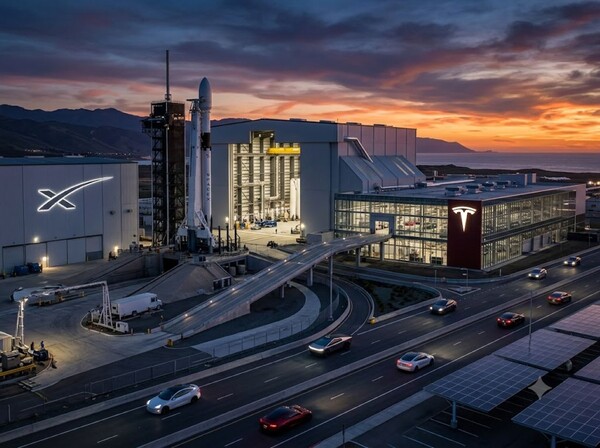
Tesla’s release of its proxy statement for its 2026 annual shareholders meeting has revealed several circumstances surrounding the possibility of a merger with SpaceX. Ira Ehrenpreis (아이라 에런프라이스), classified as an independent director at Tesla, joined SpaceX’s board in February. An analysis said Elon Musk’s compensation plan and an automatic voting system for individual shareholders are also designed in a way that could affect any future push for a merger.
Electrek, an electric-vehicle focused outlet, reported on Oct. 19 that this year’s shareholders meeting will be held on Dec. 3 at the Texas Gigafactory. Key agenda items include the re-election of Elon Musk, board chair Robyn Denholm, and director JB Straubel. The meeting will also hold a non-binding vote on Musk’s 2025 compensation plan and a vote on appointing accounting firm PricewaterhouseCoopers (PwC) as auditor. No shareholder proposals were included. Tesla will also keep its staggered board structure, with the terms of the 3 directors up for re-election this year running through 2029.
A key focus is Musk’s compensation structure. The proxy lists his 2025 pay at about $15.84 billion, but says none of it was paid in cash. The figure combines performance-based compensation and interim compensation granted in August 2025. Tesla said in a separate table that Musk’s realized compensation for 2025 was $0.
The compensation conditions change when a change in control occurs, including a merger. Musk’s 12 compensation tranches typically require meeting both market capitalization targets and operating targets. If control changes, operating targets are excluded and market capitalization is calculated using the higher of the deal price per share and the prior closing price. Awards that meet the conditions vest immediately without going through a long performance period. Based on 3.95 billion shares outstanding, if a transaction is completed that values Tesla at $3 trillion, Musk could obtain 105.9 million shares corresponding to 3 compensation tranches without meeting operating targets tied to robotaxis or Optimus, according to the calculation.
An automatic voting system for individual shareholders is also a variable. Tesla proposed allowing retail shareholders voting through ProxyVote or Robinhood to set a standing voting instruction to follow board recommendations at future meetings. Special agenda items such as mergers and acquisitions may be excluded from automatic voting, but there is no option to set an automatic instruction to oppose board recommendations. The system will apply starting from the next shareholders meeting, not the December meeting.
Attention is also on ties between the board and SpaceX. Ehrenpreis chairs Tesla’s compensation committee and governance committee, and also handles reviewing potential conflicts of interest involving directors and executives. Even so, Tesla classifies him as an independent director. With Musk leading SpaceX and Kimbal Musk, a Tesla director, having also served on SpaceX’s board, 3 of Tesla’s 9 directors have links to SpaceX.
Tesla converted its existing $2.0 billion investment in xAI into SpaceX Class A shares after SpaceX’s acquisition of xAI. The transaction closed on March 12. Tesla holds 18,991,195 shares, representing less than a 1 percent stake. Tesla also generated revenue in 2025 of $430.1 million from xAI and $143.3 million from SpaceX, mostly from Megapack and vehicle sales, respectively.
It is unclear whether a combination of Tesla and SpaceX will actually be pursued. Still, the proxy’s contents are fueling controversy over the possibility of a merger, as Musk’s compensation terms, the board’s composition and the automatic voting system could affect any future transaction.
 Yoo Seung-a
ysah@d-today.co.kr