
A technology has emerged that improves speed and costs by letting AI process inference internally rather than generating each step in text. Research findings show it can raise the inference efficiency of large language models (LLMs) while improving problem-solving capability.
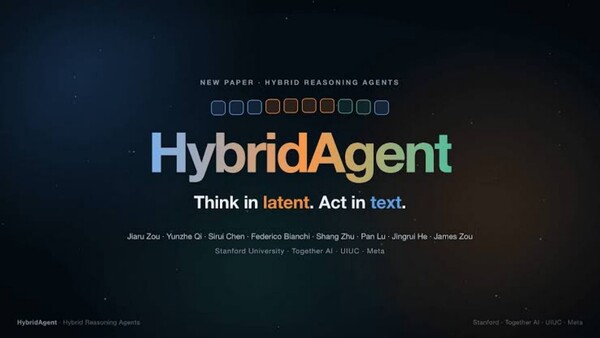
On Oct. 19, Japanese media outlet Gigazine reported that a joint research team from Stanford University, Together AI, the University of Illinois Urbana-Champaign and Meta announced a new AI inference technology called Hybrid Reasoning Agents.
Conventional LLM-based AI agents generate intermediate reasoning, tool calls and final answers as text tokens while solving problems. The more complex the task, the more tokens they generate, slowing processing and raising costs. To address this limitation, the team had AI perform intermediate reasoning in a latent space made up of numerical vectors.
The key is combining two reasoning methods. AI uses latent mode internally to solve problems and switches to text mode when calling external tools or writing the final answer.
It also applies a technology called HybridLink to maintain continuity in the reasoning process. Content handled in latent space can be displayed in a text-like form so people can check it.
The feature cannot be applied directly to existing AI models. It requires adding a supervised fine-tuning method, HybridSFT, and a reinforcement learning method, HybridRL, to a pre-trained model.
The team evaluated 11 benchmarks, including math, science and search, using Qwen3-based models with 4 billion, 8 billion and 14 billion parameters. Compared with the existing approach, the number of generated tokens fell 35.5 to 54.7 percent, and inference speed was 1.8 to 2.6 times faster.
Problem-solving performance also rose by an average of 10.4 percent over the comparators. In particular, estimated compute costs for the 4 billion-parameter model dropped to about 27 percent of the level under the existing method.
The team released related code and training data on GitHub and Hugging Face. The findings are in a paper that has not yet undergone peer review, and the performance and cost-saving effects in real service environments need further verification.
 Jae-won Choi
ittt_0801@d-today.co.kr