
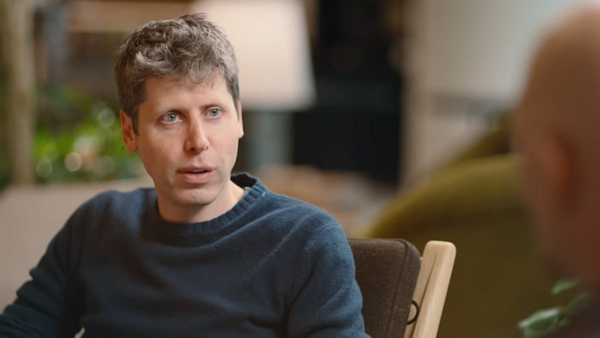
OpenAI is moving into humanoid robot development. Sam Altman (Sam Altman), OpenAI's chief executive, appeared on the podcast "Source" and said adopting a humanoid form is reasonable, adding, "We will build it."
Altman cited that the real world is designed around humans. Because doors, keyboards and various tools fit the human body, he said robots that move in the same space benefit from having a similar form.
He said what matters more is not appearance but the intelligence that runs the robot. Having arms and legs is not enough, he said, and the core is the ability to perceive surrounding objects, interpret instructions, plan actions and control the body.
Commercialisation is expected to take considerable time. Altman said in an interview with Fortune, "We will be able to show a cool demo in 2027," while adding that it will take a few more years before robots roam the streets. OpenAI did not disclose what the demonstration will show, the robot's specific form or when it will be revealed publicly.
Job postings show the development spans beyond software to real-world machine control and hardware production. OpenAI is recruiting staff in motion control, state estimation, actuator control, overall robot behaviour design and machine-learning infrastructure needed to train physical artificial intelligence (AI) systems. It is also seeking people for custom electromechanical actuator development, including motors, gearboxes, sensors and thermal management systems, as well as manufacturing and supply-chain roles.
OpenAI also has prior experience in robotics research. In the "Dactyl" project, a robot hand trained only in simulation manipulated real objects, and it later applied the same approach to solving a Rubik's Cube. It was an example showing that even if motion is learned in software, real environments require coping with physical variables.
Rivals are also speeding up humanoid development. Tesla has been developing "Optimus" for years, and Xpeng showed its humanoid "IRON" walking out on its own on a production line after assembly was completed. Stable control of complex motors and joints requires intelligent software and hardware technology working together.
OpenAI's short-term goal is closer to industrial sites than home robots. The job postings say it will first develop a general-purpose robot that supports skilled workers in infrastructure construction work, and in the long term expand to personal robots that perform a range of tasks.
Details on the price and subscription model for consumer products, the launch schedule and a robot-specific privacy framework have not been disclosed. If robots equipped with cameras and microphones move inside homes, privacy could also become an important issue.
OpenAI's recruitment page currently lists 27 robotics-related openings. The humanoid effort has moved into a concrete hiring phase, but tasks remain before an actual product launch, including technology development and mass production.
 Yoo Seung-a
ysah@d-today.co.kr