
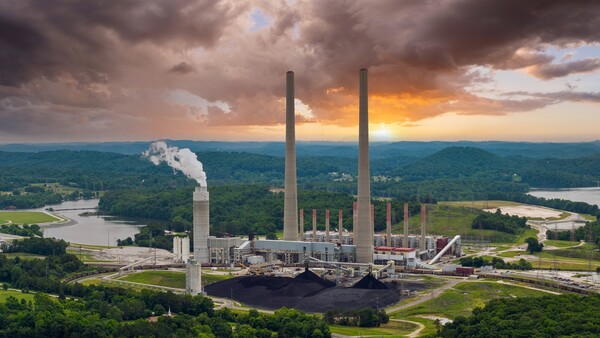
Plans to build fossil-fuel power plants in the United States, centered on natural gas, are increasing at the fastest pace in more than a decade. Surging electricity demand driven by AI data centers, factories and the spread of electric vehicles is pushing U.S. energy policy to a new turning point, an analysis said.
On Oct. 19 (local time), IT media outlet The Verge reported that the U.S. nonprofit Environmental Defense Fund (EDF) and energy policy research group Atlas Public Policy said in a recent report that plans to develop fossil-fuel power generation facilities are expanding rapidly.
An analysis of data from the U.S. Energy Information Administration (EIA) showed that as of the second quarter of 2026, fossil fuels accounted for about 30 percent of total planned new power generation capacity. Fossil fuels made up only 5 percent of newly installed generation capacity in 2024.
Fossil-fuel generation capacity planned for construction from 2026 to 2030 totals about 68 gigawatts (GW), up 45 percent from six months earlier. Most of it is natural gas power plants. If current plans proceed as scheduled, about 70 percent of newly commissioned generation capacity in 2030 could be fossil-fuel based, the report said.
Behind the shift are surging electricity demand and the Donald Trump administration's policy favoring fossil fuels. The Trump administration is restricting permitting for wind and solar projects and reducing tax support, while encouraging natural gas and coal power generation.
Renewables still lead on cost competitiveness. The report said the average levelised cost of electricity (LCOE) for new solar and wind power is $68 to $69 per megawatt-hour (MWh), lower than $90 for a new combined-cycle natural gas power plant. Cancellation rates also differed, at 4.9 percent for renewables and 2.9 percent for fossil fuels as of 2025.
Not all planned power plants will be built. A shortage of gas turbine supply and uncertainty in forecasts for data center power demand remain variables.
The researchers warned, "Expanding power generation facilities centered on fossil fuels could lead to a long-term burden of electricity bills and increased greenhouse gas emissions."
 Jae-won Choi
ittt_0801@d-today.co.kr