
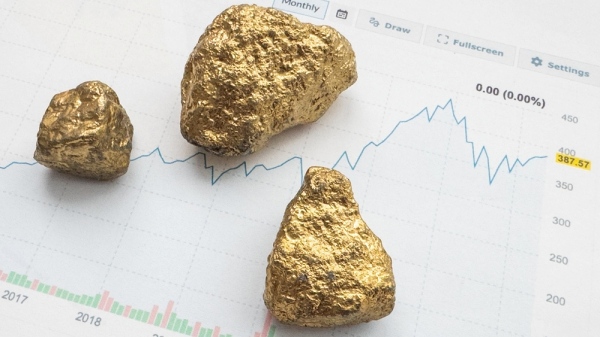
Gold rebounded after two weeks of declines as the likelihood grew that the U.S. Federal Reserve will hold interest rates steady this month. Spot gold approached $4,180 an ounce during the session.
CryptoPolitan, a blockchain media outlet, reported on Oct. 19 that the immediate driver of the rebound was a shift in the U.S. interest-rate outlook. Markets had increased the chance of further rate hikes after factoring in inflation indicators the prior week. U.S. import prices for September, led by energy, came in stronger than expected, feeding dollar strength and expectations for additional hikes.
But the mood changed after remarks by Fed Chair Kevin Warsh (케빈 워시). Warsh said the Fed may have become overly cautious because of its experience during the 2008 global financial crisis. He also said there was room for stronger growth and more investment under "good policy". Warsh stopped short of locking in the policy direction for October or December and signaled more economic data need to be assessed.
After the comments, markets sharply lowered the perceived chance of a rate hike this month. CME FedWatch showed the odds of a hike this month at 13 percent and the odds of a hike in December at about 89 percent. Because gold does not pay interest like bonds or deposits, its relative investment appeal increases as expectations for rising rates weaken.
Still, the broader direction in gold prices has not fully turned. Gold fell 0.7 percent on a weekly basis and is down almost 20 percent since tensions between Iran and the United States began in February. The market already views it as a bearish phase. Even so, steady buying demand has emerged around the $4,000 level since August, confirming that the price zone again acted as support in this rebound.
The technical picture remains a burden. Gold is holding below the 21-day, 100-day and 50-day moving averages around $4,176.14. In the near term, the 21-day moving average near $4,191 was presented as the first resistance level. Above that sit the 100-day moving average at $4,239 and the 50-day moving average at $4,327, in that order. Gold needs to close at least above the first two levels for the immediate bearish setup to weaken, and a move above $4,327 could strengthen the signal that corrective pressure is easing.
Momentum indicators are also not strong. The 14-day relative strength index stands at 46, below the neutral line of 50. That suggests buying momentum remains limited despite the rebound. If selling pressure returns, the $4,000 area, where a prior uptrend line sat, is being cited as the next key zone.
Market attention is now turning to the Federal Open Market Committee meeting and the personal consumption expenditures inflation report. The Fed uses PCE inflation as a key indicator in judging whether it is achieving its 2 percent inflation target. Warsh also said he sees artificial intelligence as having the potential to lift economic demand, but it is hard to know what effect it will have on employment.
Other precious metals rose alongside gold. Silver gained 1.3 percent to $57.73, platinum rose 1.1 percent to $1,647.75, and palladium added 1.7 percent to $1,131.29. By contrast, international oil prices fell amid expectations that Russian fuel could flow more into global markets after Donald Trump partially deferred sanctions on Russia and some tariffs.
In this environment, market participants are also monitoring the dollar's moves, social unrest in Europe, improving Chinese economic indicators and signals of easing geopolitical tensions, amid a quiet period for comments by Fed officials. Whether gold's rebound continues depends on whether shifts in rate expectations translate into the actual policy path.
 Jinju Hong
hongjj@d-today.co.kr