
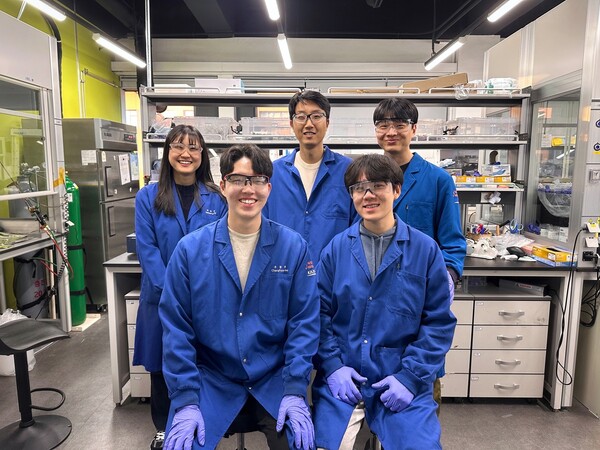
KAIST said on Tuesday that a research team led by professor Himchan Cho of the Department of Materials Science and Engineering has developed a technology that improves the light-emission efficiency of an eco-friendly nano semiconductor by 18 times.
The team developed a technique to control the surface of indium phosphide (InP) Magic-Sized Clusters (MSC), which are eco-friendly nano semiconductor particles, at the atomic level. Indium phosphide is a compound semiconductor made of indium and phosphorus and is an eco-friendly material that does not use environmentally harmful substances such as cadmium. The technology lifted light-emission efficiency from below 1 percent to 18.1 percent.
Magic-sized nanocrystals are ultra-small semiconductor particles made up of dozens of atoms. As all particles have the same size and structure, they can produce clear light. But because they are only 1 to 2 nanometres in size, most light disappeared due to surface defects. A conventional method used hydrofluoric acid to shave the surface, but it had the problem of damaging the semiconductor itself.
The researchers devised an etching strategy that precisely controls chemical reactions to occur little by little. It selectively removed only surface parts that interfere with light while maintaining the semiconductor form. Fluorine and zinc components created during the defect-removal process bonded into zinc chloride, which stably wrapped the exposed nanocrystal surface.
The achievement is at the world’s highest level among indium phosphide-based ultra-small nano semiconductors. It is more than 18 times brighter than before. The team stressed it is the first demonstration that the surface of an ultra-small semiconductor can be precisely controlled at the atomic level. The technology can be used across fields including next-generation displays, quantum communications and infrared sensors.
Cho said, "This study is not simply about making a brighter semiconductor, but an example that shows how important it is to handle surfaces at the atomic level to achieve desired performance."
The research had Changhyeon Joo, a doctoral student, and Seongbeom Yeon, a combined master’s and doctoral student, as co-first authors. Cho and professor Ivan Infante of the Basque Center for Materials, Applications and Nanostructures in Spain participated as co-corresponding authors. The findings were published online in the Journal of the American Chemical Society on Dec. 16 last year. The work was supported by the National Research Foundation of Korea’s Nano Materials Technology Development Project, Next-Generation Intelligent Semiconductor Technology Development Project, and Quantum Information Science Human Resource Foundation Building Project, and the Korea Basic Science Institute’s infrastructure support project for early-career researchers.
 Daegeon Seok
d2dg@d-today.co.kr
Daegeon Seok
d2dg@d-today.co.kr