
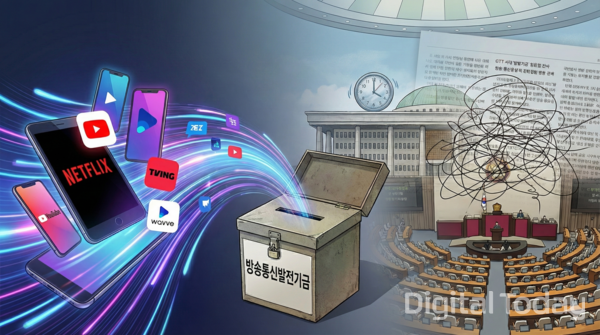
Discussion on restructuring the Broadcasting and Communications Development Fund has failed to reach a conclusion for years. Some have recently called for expanding and reorganising it into an “audiovisual media development fund.”
Hong Jong-yoon (홍종윤), a professor in the Department of Communication at Seoul National University, recently presented a plan at the Korean Association for Journalism and Communication Studies’ autumn conference to fully overhaul the fund into an audiovisual media development fund that supports development across the broader audiovisual media industry.
The plan calls for expanding contributors beyond existing broadcasters to include multiple programme providers (MPP) above a certain size, online video services (OTT) and platforms. It also calls for using the funds raised to support regional and smaller media and strengthen content diversity.
In the short term, Hong proposed unifying the differing levy standards across operators into broadcasting-related revenue. He also proposed introducing progressive collection rates and a reduction system that consider ability to pay and public interest. In the long term, he said it is necessary to redefine the fund’s nature and the scope of those subject to contributions in connection with building a legal framework for audiovisual media services.
Hong said, “A system that imposes the fund burden only on existing broadcasters and excludes operators newly entering the audiovisual media market is not sustainable.” He added, “Simply expanding the scope of those subject to contributions due to a lack of funds is also difficult to justify.”
Discussion on restructuring the fund has continued for years, focusing on overlapping support programmes among funds, the appropriateness of resource allocation and fairness in contributions by operator.
Calls are also growing to integrate the fund with the Information and Communications Promotion Fund.
The need for integration has been raised because the two funds overlap in support targets and project areas in the information and communications technology (ICT) sector and use spectrum assignment fees as a common funding source.
A government fund evaluation panel recommended integrating the two funds again this year, after doing so in 2020 and 2023. In “2026 fund evaluation results” reported to a Cabinet meeting by the Ministry of Planning and Budget in May, overlaps in policy targets and support areas stemming from ICT convergence and the spread of the AI industry were presented as the basis for the recommendation.
But as a full integration has been delayed, there are also calls to start by sorting out overlapping projects.
One approach is to reallocate ICT industry promotion projects to the Information and Communications Promotion Fund and public interest and promotion projects related to broadcasting to the Broadcasting and Communications Development Fund. The pay-TV industry has also presented a view that ICT-related resources should be integrated into the broadcasting fund and the funding structure itself redesigned.
The Broadcasting, Media and Communications Commission in May commissioned a research project through the Korea Communications Agency (KCA) to review redesigning levy standards and collection rates by project group, improving exemptions and reductions, and diversifying revenue. It said it will review specific restructuring directions based on the research results.
An official at the commission said, “The research results were originally scheduled to come out at the end of November, but after final discussions and wrap-up work by the research group, they are expected to come out around the end of December.” The official added, “Based on the research, we will reflect what is needed and review what is realistically difficult as a mid- to long-term task.”
On converting it into an audiovisual media development fund, the official said, “To newly impose contributions on OTT services and others, there are many matters that need to be reviewed comprehensively, so it could be one of several alternatives.” The official also said integration with the Information and Communications Promotion Fund is a separate matter from the current research project.
 Son Seul-gi
sageson@d-today.co.kr