
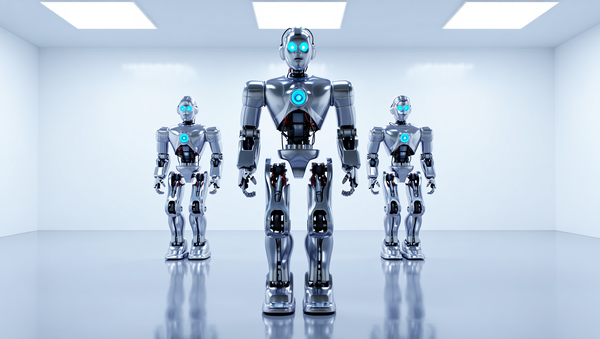
A new assessment says the robotics industry, including humanoid robots, is still in an early stage where even core components and safety systems have not matured.
Cryptopolitan, a blockchain media outlet, reported on Oct. 17 local time that Amulya Vishwanath (아물리야 비슈와나스), a former Nvidia robotics executive and founder of Techable venture capital, described the current robotics industry as being in a "Lego era".
Vishwanath said on a TechCrunch podcast the previous day that the industry’s basic building blocks, including actuators, robot hands, software and safety protocols, are still under development. He worked for 7 years in robotics product marketing at Nvidia before moving into early-stage investing in physical AI.
Views within the industry are mixed. Pim de Witte (핌 더 비테), chief executive of General Intuition, said a single general-purpose robotics model could replace much of today’s specialised robot work. By contrast, Zhang Jianzhong (장젠중), chairman of Moore Threads, said humanoids still have a way to go before reaching a "ChatGPT moment".
Market researcher Gartner also took a conservative view. Gartner predicted that by 2028, fewer than 100 companies will directly use humanoid robots. It expected fewer than 20 companies to deploy them for production purposes at manufacturing and supply chain sites. The firm cited limited dexterity, high costs and battery life as key constraints.
Actual adoption also supports that assessment. IDC said global humanoid robot shipments in 2025 exceeded 18,000 units, with about 95 percent coming from Chinese manufacturers. But 85 percent of total shipments were for performances, education, data collection and tour guidance, rather than industrial production. IDC forecast shipments will exceed 510,000 units in 2030, but it is still hard to say humanoids have become the mainstream in factory automation.
Conventional industrial robots, a point of comparison, are much further ahead. The International Federation of Robotics said new industrial robot installations in 2024 totalled 542,000, and the number of operational robots worldwide reached about 4.7 million. Shipment volumes and installation counts are hard to compare directly, but it is clear that conventional robots already have a firm footing in factory automation.
Physical AI investment has not been focused only on humanoids. Crunchbase data showed there were 521 physical AI-related investments in the first half of 2026, totalling $47.4 billion, about four times the level of the previous half-year. The category includes vehicles, defense, drones and sensors. Among individual investments, Waymo was the largest at $16 billion, followed by Anduril at $5 billion, Shield AI at $2 billion and Saronic at $1.75 billion.
Commercialisation outside factories has moved faster. Waymo said it completed 15 million robotaxi rides in 2025, and raised about $16 billion in February 2026. Specialised artificial intelligence systems have already proven their business potential, while general-purpose humanoids are still at the stage of searching for broad use cases.
Gartner named physical AI agents as one of the "four factors" changing factory environments. Still, the solutions companies can choose right now are closer to adopting specialised systems first than to going all-in on humanoid robots. As a result, near-term market opportunities are more likely to be concentrated in automation, sensors, computing and software than in finished humanoid products.
 Yoonseo Lee
yslee@d-today.co.kr