
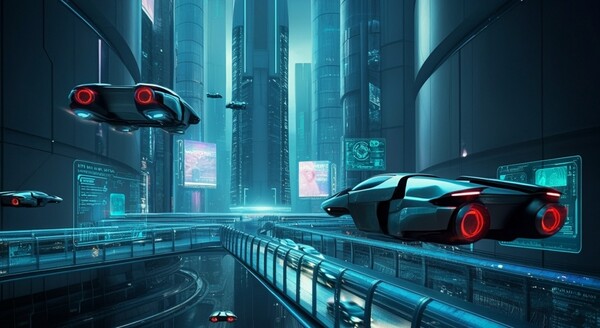
Florida has not spent $197 million in federal subsidies allocated to expand charging networks for electric cars and electric trucks, while pushing ahead with a plan for an “aerial highway network” for flying cars, fuelling controversy. Tesla also faced criticism that it is focusing on flashy visions of the future rather than practical electrification infrastructure after a demonstration at the unveiling of its new Roadster evoked levitation.
CleanTechnica, an electric vehicle outlet, reported on Oct. 18 local time that the Florida Department of Transportation is reviewing an “Aerial Highway Network” concept that would include hubs where flying cars can charge and take off and land. Federal funding earmarked for building a fast-charging network for EVs has not yet been put into actual projects, it said.
At the centre of the controversy is what should take priority: charging infrastructure needed now or future modes of transport that remain limited in commercialisation. In a related report, the Florida Department of Transportation said it does not intend to use taxpayer money on everyday passenger cars. That could be interpreted as a lukewarm stance on supporting EV charging infrastructure. It has not been confirmed whether a decision has been made to fund the flying car concept with actual budget support.
The backdrop to the debate is the bipartisan U.S. infrastructure law enacted in 2021. The law 마련ed funding to expand fast-charging networks for electric cars and electric trucks along highways nationwide. A main goal is to expand charging facilities within 1 mile of highways.
Charging facility operators can move projects forward by covering about 80 percent of total installation costs with federal support and paying the remaining 20 percent themselves. Fuel and convenience operators such as Buc-ee's and Wawa have also been cited as potential beneficiaries of the expanded charging network. Critics have pointed to the fact that, in Florida, the funding has not translated into an actual expansion of charging facilities.
Tesla’s new Roadster unveiling has also drawn criticism for prioritising futuristic staging over practical technical challenges. Tesla CEO Elon Musk (일론 머스크) introduced the next-generation Roadster as an “intentional prototype”. At the event, the car was shown rising into the air, changing its attitude, landing using an air-jet device and then accelerating again.
The spectacle evoking levitation drew more attention than the driving performance of a conventional electric sports car or mass-production plans. The demonstration is seen as intended to underscore the next-generation Roadster’s technical potential, but details such as which features and performance will be implemented in a production car, along with a release timeline, need to be verified separately.
Tesla is a leading company that has driven EV adoption and the expansion of charging infrastructure. Because it has built its own charging network and expanded its influence in the EV market, it has also faced criticism that the Roadster unveiling put more weight on visual buzz than on substantive product development. CleanTechnica also raised questions about the announcement’s potential impact on Tesla’s share price.
The two cases unfolded in different arenas, but both highlight a gap between expectations for future technology and current practical challenges. Florida is reviewing a concept for aerial transport while leaving already allocated charging infrastructure funding unspent. Tesla, a key player in the EV market, showcased a next-generation vehicle, but the unveiling emphasised flying-like staging over driving on roads.
The key going forward is whether the concepts lead to tangible results. Florida’s policy priorities are expected to emerge depending on whether it puts federal subsidies into expanding charging networks or develops the aerial highway network plan. Tesla also needs to present actual product performance and mass-production plans beyond the Roadster demonstration.
Investment in future mobility can drive technological innovation, but it must also consider commercial viability, social necessity and shortages in existing infrastructure. The dispute is asking whether a flashy vision of the future can replace real-world electrification challenges.
 Jinju Hong
hongjj@d-today.co.kr