
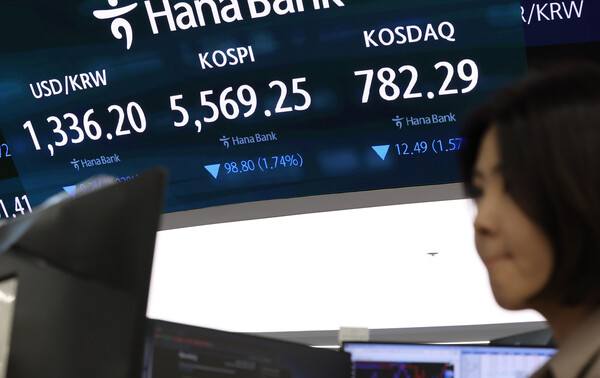
The KOSPI opened lower, hit by the fallout from a sharp fall in U.S. artificial intelligence (AI)-related stocks.
As of 9:11 a.m. on the 19th, the KOSPI was down 75.71 points, or 1.34 percent, from the previous session at 5,592.34. The index opened at 5,488.41, down 179.64 points, or 2.29 percent, from the previous close of 5,668.05.
In terms of supply and demand, foreign investors and institutions are supporting the index. Foreign investors were net buyers of 149.0 billion won in the main board market, and institutions bought a net 202.6 billion won. Retail investors sold a net 364.7 billion won.
Among the top stocks by market capitalisation, chip shares are weak. Samsung Electronics was trading at 213,250 won, down 1.04 percent from the previous session, and SK Hynix was down 2.04 percent at 1,246,000 won.
SK Square was down 1.91 percent and Samsung Electro-Mechanics fell 3.03 percent. Hyundai Motor was down 1.12 percent, KB Financial Group slid 1.50 percent, and Samsung Life Insurance fell 1.26 percent.
LG Energy Solution, meanwhile, was up 0.62 percent. Samsung Biologics was also rising, up 2.23 percent.
The KOSDAQ is also weak. At the same time, the KOSDAQ was down 4.77 points, or 0.60 percent, from the previous session at 790.01.
The won-dollar exchange rate was at 1,335.60 won, down 2.40 won from the previous session.
Weakness in AI-related stocks in the U.S. market last Friday is weighing on the domestic market. On Oct. 16 (local time), the Dow Jones Industrial Average fell 0.34 percent, the Standard and Poor's 500 index fell 1.09 percent and the Nasdaq index dropped 2.10 percent. As concerns persisted over the profitability of AI infrastructure investment and the burden of financing, technology shares fell by a relatively large margin.
Han Ji-young (한지영), an analyst at Kiwoom Securities, said the domestic stock market this week is expected to see a highly volatile week as instability in the AI industry resurfaces following last Friday's sharp fall in U.S. AI stocks.
She added that the market could secure downside support after earnings announcements by major companies, including U.S. big tech firms and key domestic companies such as power equipment and defence.
Han said it is also time to consider that the domestic market has seen an excessive correction compared with other markets in terms of the magnitude of the fall in stock prices. She said it would be appropriate to reflect in response strategies that stock prices could rebound at the current level of the index, which has fallen to the 5,000 level, even if it faces downward pressure during the week.
 Oh Sang-yup
yub@d-today.co.kr