
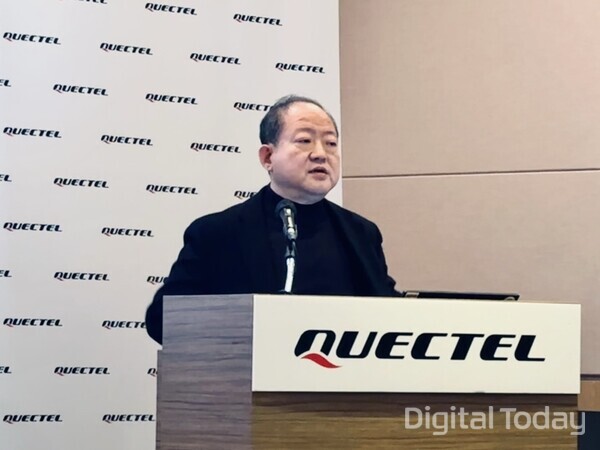
South Korea's IoT market is rapidly shifting from module-based development to the ODM (original design manufacturer) model due to a shortage of developers and the burden of R&D. Quectel is moving to shorten time to market by supporting the entire process from design to production through its unit IQTek.
Quectel Wireless Solutions assessed at a media briefing held on Tuesday at the FKI Tower in Seoul's Yeongdeungpo district that the Korean IoT market has reached a structural turning point. Lee Sang-heon, head of Quectel Technology Korea, said the market is rapidly shifting from module-based development to ODM manufacturing as the population ages and the number of developers declines. He said South Korea is now fully facing changes Japan has already experienced.
In the early 2000s, South Korea's IoT industry saw makers of RF devices and POS terminals buy modules directly and develop products in-house while employing more than 100 engineers. Change accelerated as young developers moved into the games and platform industries, making it harder to secure hardware developers.
Lee said companies used to build products by combining modules with other components, but the market is now transitioning to a model in which firms receive finished products or PCB-format supplies and focus only on branding.
Quectel is responding to the shift through its unit IQTek. Shim Sang-woo, IQTek Asia-Pacific sales director, said it supports the full process from design to production so customers can launch products with minimal staff even without R&D capabilities. He stressed that shortening time to market and cutting costs are the core value of ODM. Since its establishment in 2019, IQTek has strengthened expertise by assigning 70 percent of its more than 500 employees to R&D.
The shift to ODM is a strategic choice to improve market responsiveness, not simply cut costs. Shim said companies can respond flexibly by operating multiple vendors in rapidly changing market conditions such as a memory shortage crisis. He said customers can launch products quickly while minimising technical risk.
Most GPS trackers supplied to South Korea's shared kickboard market are IQTek products. It has taken control of the market by providing an integrated solution covering location tracking as well as payment and status monitoring. IQTek also supplies, under the ODM model, FWA equipment for home networks sold to telecom companies and public WiFi equipment installed in subways and buses.
Companies choose ODM for cost and speed. Lee said firms can cut the burden of hiring developers and reduce R&D risk while using already verified technology to quickly launch competitive products. The analysis said precedents in Japan, where Canon, JVC and Panasonic have already adopted ODM, are accelerating the shift among Korean companies.
Quectel is the top company in the global cellular IoT module market, accounting for half of the market, and its share in South Korea exceeds 60 percent. Lee said last year's South Korean sales topped 100 billion won. He said the shift to ODM is a key growth driver, given sales were around 8 billion won when it entered the market in 2019.
"The next market is autos... supplying products to Tesla and GM self-driving cars"
Another growth driver Quectel is focusing on is the SDV (software-defined vehicle) market. Lee said cars are changing from hardware whose functions were fixed once built into devices that evolve like mobile phones. He said AI and OTA (over-the-air updates) are at the core of the shift.
In the past, all parts and functions were finalised three years before mass production of a car. This is also why navigation systems in vehicles consumers buy can feel outdated. In the SDV era, vehicles learn driver patterns and upgrade functions in real time. Lee said Tesla and GM Cruise self-driving vehicles already carry Quectel communications modules, and the autonomous driving system of Hyundai Motor affiliate Motional also uses Quectel technology.
The spread of SDVs has also sped up as 5G networks act as a catalyst, Lee said. He said if pre-5G networks were like a car driving in the desert, 5G provides a highway. He said ultra-low-latency communications have enabled real-time data processing and remote control. He also said the market for "cobots", where robots and humans collaborate in the same space, has begun in earnest thanks to 5G.
Quectel is responding to market changes based on eight R&D centres worldwide and annual production capacity of 300 million units. Lee said it will support the diverse needs of Korean customers with end-to-end IoT solution capabilities. He said the company will evolve from a module supplier into a total solution partner.
 Seok Dae-geon
d2dg@d-today.co.kr
Seok Dae-geon
d2dg@d-today.co.kr