
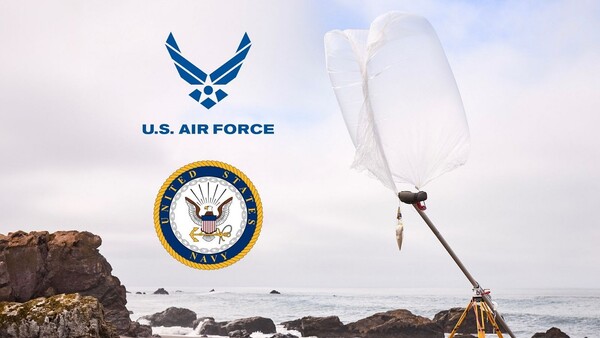
The U.S. Air Force has signed a contract worth up to $49 million to secure atmospheric data collected by autonomous weather balloons floating around the world. It is a move to use data from a private company that combines AI and weather observation technology for military operations.
TechRadar reported on Oct. 18 local time that the Air Force signed a weather data supply contract with California startup WindBorne Systems. The ceiling value is about $49 million, but the actual purchase amount will vary depending on military demand. About $1.7 million has been ordered so far.
WindBorne Systems currently operates about 700 autonomous weather balloons worldwide. The balloons carry sensors that measure atmospheric conditions, and the collected information is used for weather forecasting and AI model development.
The balloons can move to targeted areas without an engine. They change altitude by adjusting internal air and sand ballast, then control their routes by using wind direction and speed that differ by altitude.
In August, the company succeeded in moving an autonomous weather balloon into the eye of Typhoon Dolphin to collect atmospheric data. The company described it as the first case of guiding an unpowered balloon into the center of a typhoon.
WindBorne Systems co-founder and chief technology officer Andrey Sushko (앤드레이 수시코) said sophisticated weather models and a sufficiently large balloon network made the results possible. He also stressed it was an early case of applying deep learning models to real operational decision-making.
The contract was signed without competitive bidding. The Air Force can buy observation data for specific regions and periods whenever needed, and the contract runs through September 2033.
WindBorne Systems plans to expand its balloon network and push ahead with hardware research and development on the back of the contract. It also uses observation data for its in-house AI weather forecasting system, WeatherMesh 6, and claims it is more accurate than existing European weather forecasting models. Independent verification is needed on any performance advantage.
 Jae-won Choi
ittt_0801@d-today.co.kr