
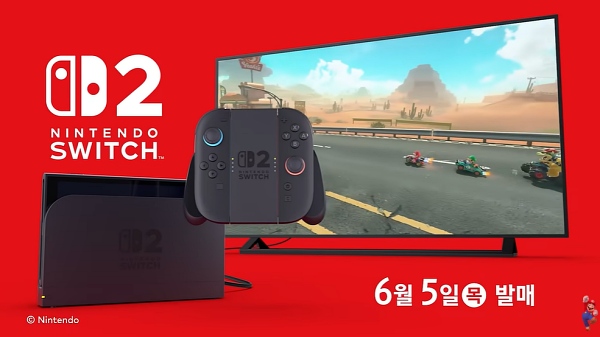
Nintendo is closely monitoring its business strategy for the next-generation Switch 2 console while maintaining hardware profitability despite rising RAM prices and unstable memory supply.
On Jan. 13 local time, IT outlet TechRadar reported that Nintendo President Shuntaro Furukawa said he is watching an industry-wide RAM shortage and closely reviewing various factors that directly affect hardware profitability.
Furukawa said the Switch 2 is less profitable than the existing Switch and that decisive factors include parts procurement terms, cost reductions through mass production, and the impact of exchange rates and tariffs. He said the memory market is highly volatile but has no immediate impact on earnings and is something to watch closely. He stressed that Nintendo is focusing on stable production and supply chain operations based on a mid- to long-term parts procurement strategy rather than short-term profit. Securing price competitiveness through procurement, improving production efficiency and responding flexibly to market changes are emerging as key tasks for future hardware strategy.
Furukawa called any potential Switch 2 price changes hypothetical and avoided specific comment, but acknowledged that external factors such as a 145 percent tariff implemented in the United States could have negative effects in global markets, including Japan.
He added: "We treat tariffs as costs, and our basic policy is to reflect them in prices to the extent possible." He said the company is carefully considering market conditions while maintaining momentum for hardware adoption and platform growth. He stressed that the global economic environment, exchange-rate swings and supply chain risks are being assessed comprehensively and treated as important factors in deciding the Switch 2's pricing and launch strategy.
The Switch 2 got off to a strong start, selling more than 10 million units by the end of 2025 despite delayed preorders in the United States and Canada at launch last year. Furukawa said that despite unstable DRAM supply sparked by AI data center demand, Nintendo is pursuing stable parts procurement in line with its mid- to long-term business plan and continues a strategy that balances hardware profitability with growth in its games business. He also stressed that the game software lineup linked to the Switch 2 and a platform expansion strategy are important pillars supporting hardware profitability.
The remarks show that Nintendo is seeking to protect profitability in its next-generation hardware business, including the Switch 2, while also promoting the expansion of its gaming platform and a larger market share despite volatility in the global memory market and tariff burdens.
 Kyungmin Hong
hongm@d-today.co.kr
Kyungmin Hong
hongm@d-today.co.kr