
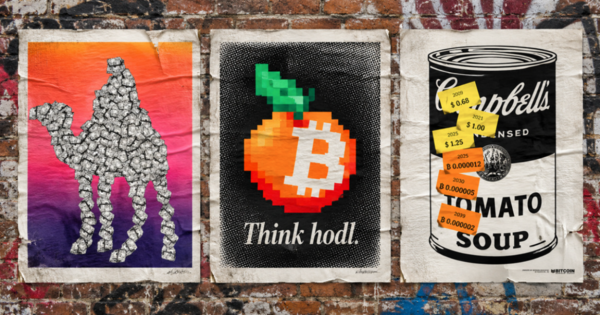
An exhibition in Amsterdam will spotlight Bitcoin not as an investment asset but as a subject for art and social critique. Three artists explore the structure of money and shifts in Bitcoin culture through works that destroy banknotes to question the authority of currency and visualise the value of the dollar measured in Bitcoin.
Bitcoin Magazine, a blockchain outlet, reported on Oct. 14 that three European artists - Jetra, RYR and Cypherpunk Now - will present works as part of the BMAG program at the Bitcoin Amsterdam event running from Nov. 4 to 6.
The exhibition draws attention for treating Bitcoin not only as technology or an investment product but as a cultural subject and a medium for criticising existing monetary systems. It uses the language of art to show how money is created, circulated and concentrated among a few, and how early ideals have changed as Bitcoin is absorbed into mainstream finance.
Amsterdam, where the exhibition is held, is a city with a historical context around money and speculation. It is where the print collection The Great Mirror of Folly satirising financial overheating during the collapse of Europe’s speculative bubble in 1720 was published, and where David Chaum founded DigiCash around 1990 to run an experiment in private electronic money. Earlier, BMAG also visualised the flow and structure of money through an exhibition titled The Waterworks of Money, which compared the monetary system to a vast irrigation network.
RYR, who started in Germany’s graffiti culture, presents work that directly dismantles currency, including shredding banknotes into paper and using ash from burned notes as pigment. The exhibition also includes a concrete hand grenade-shaped piece filled with cut cash. The work reflects a view of money not merely as a means of exchange but as a structure through which social belief and power operate.
RYR described money as a "narrative system built on collective belief and obedience". The act of destroying banknotes is not simple damage, RYR said, but a process of breaking up an existing story to create a new one. By dismantling physical currency, the work shows that money’s value is formed not by the paper itself but by social agreement and belief.
Jetra uses the BIP39 word list used for Bitcoin wallet recovery phrases and changes in Bitcoin’s purchasing power against the dollar as materials. Jetra’s Tomato Soup series reinterprets Andy Warhol’s soup can image and shows both rising dollar prices and shifts in value in Bitcoin terms. It uses familiar consumer goods imagery to make purchasing power and inflation visually apparent.
Jetra said Bitcoin users easily understand the work because of the way inflation weakens the purchasing power of fiat currency. In the BIP39 series, Jetra converts each of the 2,048 words, a symbol of self-custody, into a physical image. It translates the idea of digital wallet security and individual control over assets into artworks.
Martin Fischer (마르틴 피셔), who works as Cypherpunk Now, looks back on Bitcoin’s early spirit and today’s changes. Fischer, from the Czech art collective Ztohoven, co-founded the hackerspace Paralelni Polis, which ran a cafe that accepted only Bitcoin in 2014. He explained that Bitcoin was seen then less as a means of accumulating wealth than as uncensorable money, and that the focus was on its potential to change society rather than on speculative value.
Fischer invested a large part of his earnings into his next work even after first selling prints for Bitcoin in 2017. The early culture that embraced Bitcoin not simply as a transaction tool but as something that enabled new activity outside the existing financial system is reflected in his work.
The concern shared by the three artists is Bitcoin’s entry into the mainstream. As banks, investment funds and companies accept Bitcoin, the market has broadened, but tension is forming with the ideals of the early movement that emphasised resistance to censorship and financial independence.
Fischer said that because Bitcoin is deeply intertwined with traditional finance, it is now difficult to define it only as an anti-establishment movement. He added that while he interprets mainstream adoption not as a betrayal of early ideals but as a natural result of success, he is not simply satisfied with the current direction.
RYR also pointed out that it is still unknown whether Bitcoin will succeed in challenging the existing financial system or eventually become part of the system it sought to change. RYR said that even as digital payments spread and money increasingly shifts into an invisible form, there is still something interesting in work that expresses value as a physical object.
The exhibition is expected to examine what has endured and what has changed as Bitcoin moves from a fringe culture into a mainstream financial asset. Works by the three artists dealing with the authority and purchasing power of money, the meaning of self-custody and shifts in Bitcoin’s early spirit will be on view at Bitcoin Amsterdam from Nov. 4 to 6.
 Jinju Hong
hongjj@d-today.co.kr
Jinju Hong
hongjj@d-today.co.kr